Share
Share


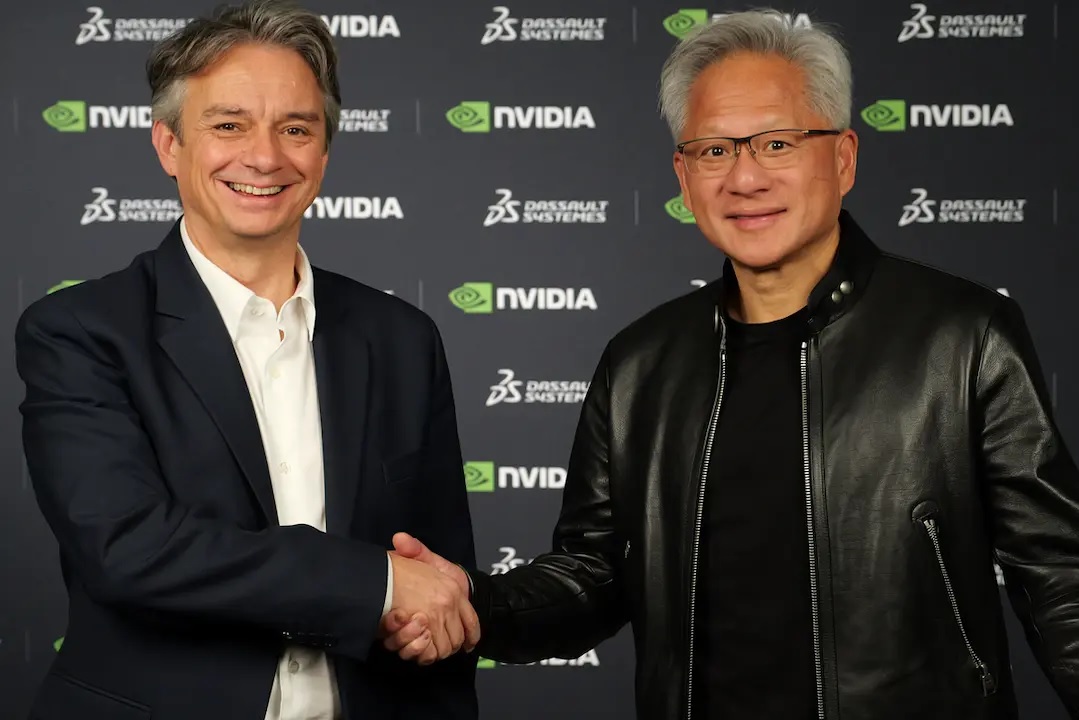
HOUSTON (Feb 4): The future of design will be done entirely on virtual twins as the products will be software-defined, said Nvidia co-founder and chief executive officer Jensen Huang.
A virtual twin is a digital copy of the real world that is able to simulate real world physics onto a 3D model, compared to a digital twin that is a passive replica for monitoring and sensing.
The world is going through a re-industrialisation with artificial intelligence (AI), and Nvidia plans to support and navigate the complexities of upcoming AI factories by harnessing the power of the fusion of simulation and AI.
“The way that people used to think about designing products, is they design the product and they build the factory. In the future, it's very likely that the products that you are able to design and build will be impacted by the factories you design and build…but it will be simulated and operated completely inside a virtual twin,” said Huang at 3DExperience World 2026 at the George R Brown convention centre.
He added that semiconductor and computer computers will start to be intertwined and be critical in creating the infrastructure for intelligent manufacturing.
This vision follows the announcement of Nvidia’s partnership with Dassault Systèmes to establish a shared industrial architecture for mission-critical AI across industries and reach a shared long-term vision for how industrial AI will be built, validated and deployed at scale.
“Together with Nvidia, we are building industry world models that unite virtual twins and accelerated computing to help industry design, simulate and operate complex systems in biology, materials science, engineering and manufacturing with confidence.
“This partnership establishes a new foundation for industrial AI, one that is trustworthy by design and capable of scaling innovation across the generative economy,” said Pascal Daloz, the CEO of Dassault Systèmes.
Nvidia is adopting Dassault Systèmes model-based systems engineering to design AI factories, starting with the Nvidia Rubin platform and integrating into the Nvidia Omniverse DSX Blueprint for large-scale AI factory deployment.
“We want to simulate or emulate how [AI] factories will operate in the real world so that we can arrange manufacturing lines properly, arrange it in the right sequence, space it properly, organise the robots within it, run the robot AIs so that these AI robots could be operating inside the factory, manipulating things, assembling things, moving things, and keeping things safe. All of this is going to happen inside a virtual twin,” said Huang.
Unlock Malaysia’s shifting industrial map. Track where new housing is emerging as talents converge around I4.0 industrial parks across Peninsular Malaysia. Download the Industrial Special Report now.