Share
Share


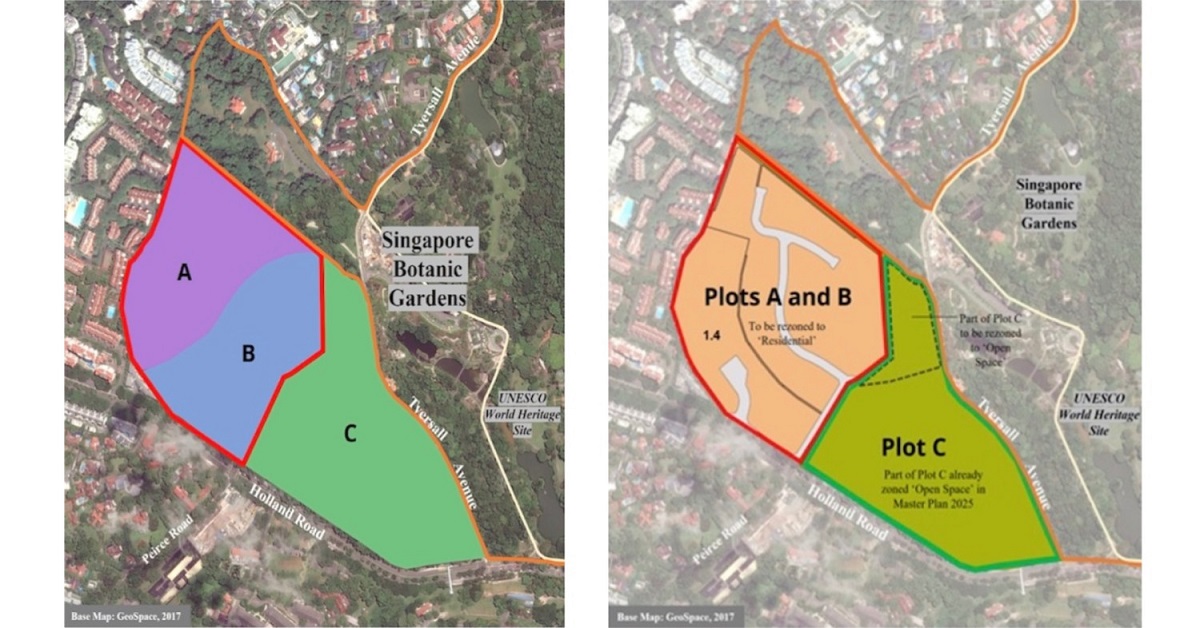
SINGAPORE (March 18): The Urban Redevelopment Authority (URA) said on March 17 that it has received a development application for land parcels on Holland Road owned by the Regent of Johor, Tunku Ismail Sultan Ibrahim, following a land swap with the Singapore government in June 2025.
URA is proposing to rezone the parcels for residential use. The Regent of Johor (ROJ) has submitted plans to develop the site into low-rise, low-density housing with a gross plot ratio of 1.4, including Good Class Bungalows (GCBs).
The sites earmarked for residential rezoning — Plot A and Plot B — have a combined land area of 16.6ha. Meanwhile, the Singapore government will retain Plot C, which spans 13ha and is currently zoned “Open Space” and “Special Use”. The site remains undeveloped, with URA stating in a March 17 release that it is “keeping open our future plans for the area”.
Should the entire 16.6ha site be developed into a landed residential enclave, it could yield approximately 100 to 200 low-rise, low-density homes, including GCBs, depending on the final planning parameters, says Marcus Chu, CEO of ERA Singapore.
If the rezoning is approved, it could lead to the creation of "a new GCB area", increasing the number of gazetted GCB areas from 39 to 40 and introducing a distinct luxury housing enclave within the highly desirable District 10, Chu adds.
The release does not specify the lease tenure for the rezoned residential sites at Plots A and B, but the freehold tenure is expected to remain unchanged, says Mark Yip, CEO of Huttons Asia. “This is a prime and highly coveted location in prime District 10; it is near Cluny Hill and the Gallop Road/Woollerton Park GCB areas.”
Additional buyer’s stamp duty (ABSD), along with conditions requiring developers to sell all units within five years — particularly for projects with at least five residential units — typically applies to land acquisitions. “As this is a land swap, ABSD may not be payable,” adds Yip. However, land betterment charges should be payable as the development involves a change of use.
With the government intending to take in up to 30,000 new citizens annually, some ultra-high-net-worth individuals may consider acquiring GCBs — widely regarded as the ultimate status symbol for the wealthy, Yip reckons.
Mohan Sandrasegeran, head of research and data analytics at SRI, says the proposed rezoning “presents a rare opportunity” to introduce new supply into Singapore’s highly constrained GCB market.
“Land within designated GCB areas is extremely limited and tightly held,” he notes, adding that any new supply entering this segment is therefore significant.
The timing is also notable, as activity at the top end of the bungalow market has shown signs of recovery. In 2025, about 30 GCB transactions were recorded based on caveats lodged, up from 23 in 2024, says Sandrasegeran. “It reflects a gradual return of participation among high-net-worth buyers.”
He adds that the proposed rezoning underscores a strong emphasis on heritage preservation, environmental sensitivity and long-term urban liveability — key considerations shaping Singapore’s high-end residential landscape.
..........
EdgeProp's inaugural monthly print edition is fresh off the press! Free delivery is available for selected regions. Subscribe now.
.jpg?sCKFImEqUesBHXT_lIvjplKjBWFpqpUp)