Share
Share


The Malaysian property market has historically functioned as a key pillar of national economic development, moving through distinct cycles of expansion and correction.
Current market outlook: Early uprising
As of 2025, the market has entered a phase of mature stabilisation. This follows a decade-high transaction value of RM241.87 billion, even as transaction volume registered a marginal 1% decline to 416,413 units.
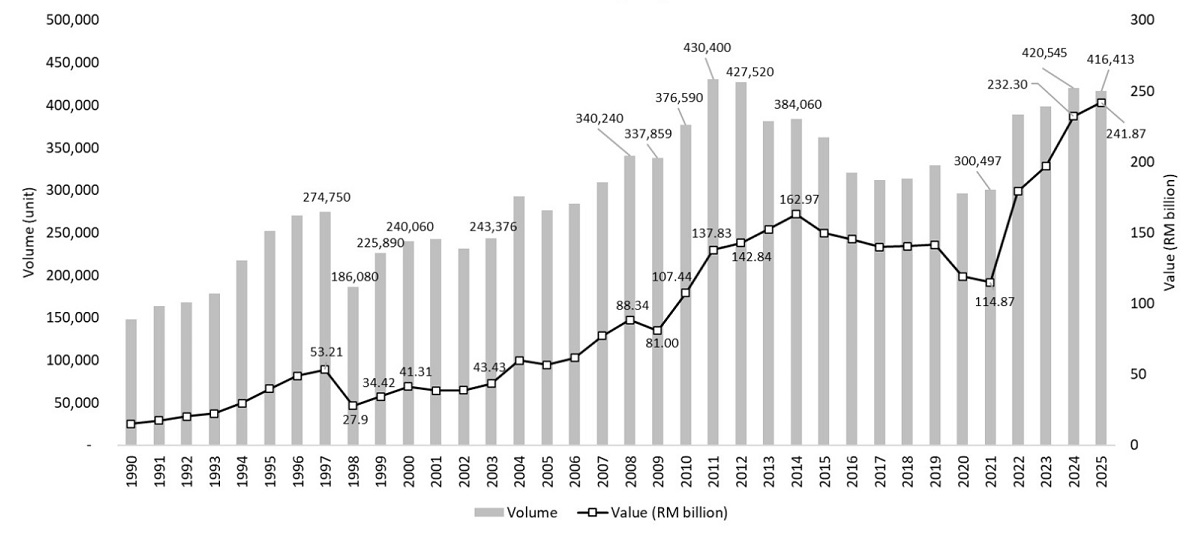
At a surface level, this suggests resilience. However, a closer reading reveals a market that is no longer moving in unison.
What stands out most clearly today is the divergence between asset classes. Growth is no longer broad-based, but increasingly selective:
*The industrial sector has expanded at a 14.7% CAGR in the post-pandemic period, despite accounting for just 14% of total market share.
*The commercial segment follows at 12.5% CAGR, supported by improving occupancy in prime assets.
*Meanwhile, the residential sector, although dominant at 44.8% market share, has grown at a slower 6.9% rate.
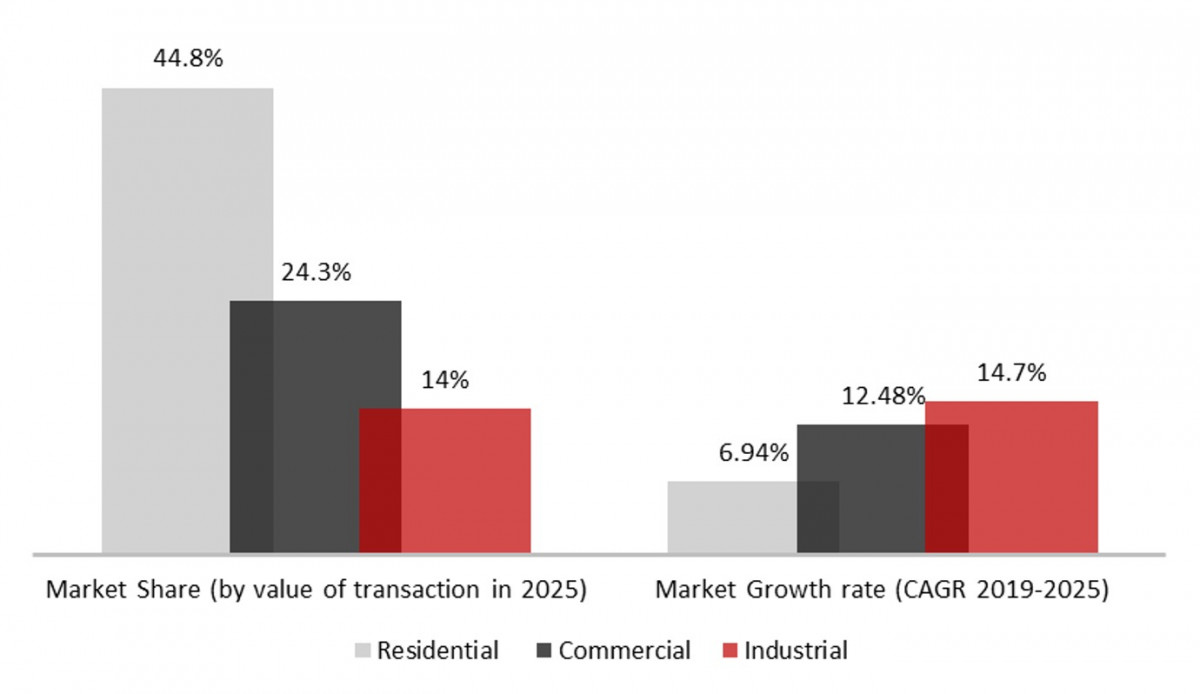
This signals a structural shift. The market is no longer driven by momentum, but by quality, relevance, and alignment with infrastructure and economic trends.
After five consecutive years of growth (2021–2025) — supported by investments in data centres, logistics, and infrastructure, alongside a post-pandemic flight to quality — the prevailing industry view is that 2026 marks the beginning of a new cycle.
I acknowledge this perspective, but I also believe it warrants closer scrutiny.
From super-boom to structural reset
To understand where we are, we must first understand what has just concluded.
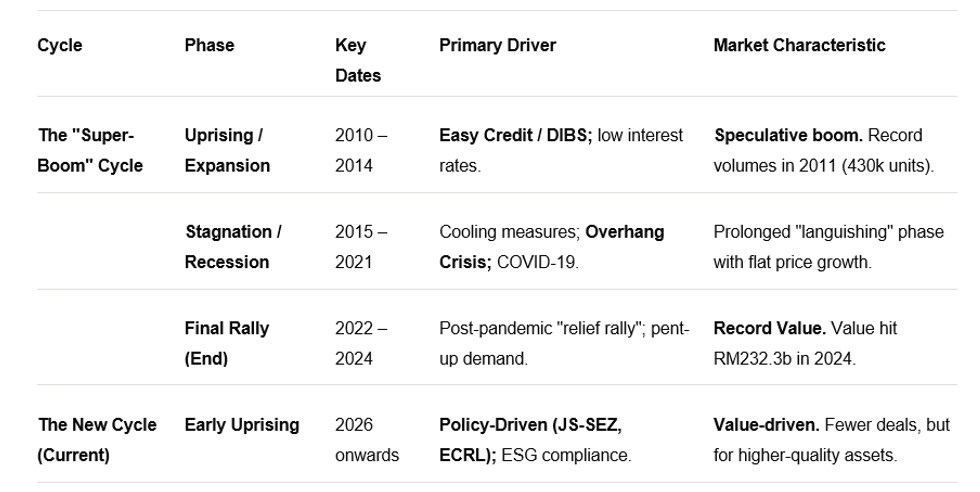
The 2010–2025 period, which I describe as the “Super-Boom Cycle”, unfolded in three distinct phases. It began with an expansion phase (2010–2014) driven by easy credit and speculative mechanisms such as DIBS (developer-interest- bearing scheme).
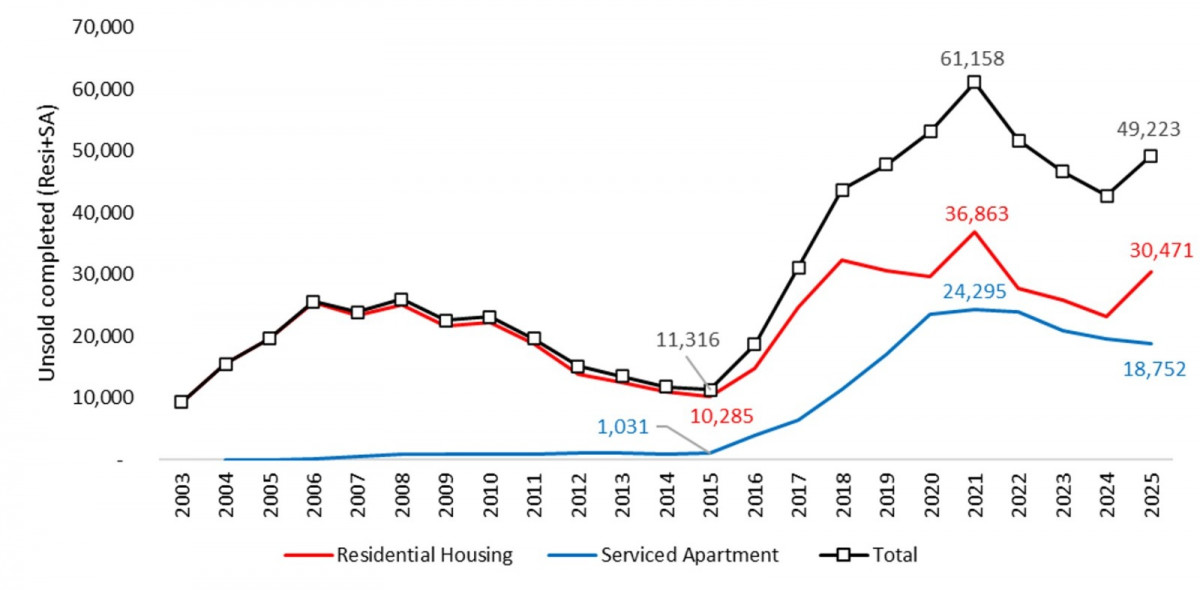
This was followed by a prolonged stagnation period (2015–2021), shaped by policy tightening, an overhang crisis, and ultimately the Covid-19 shock.
The final phase — the 2022–2024 rally — was a relief-driven rebound, fuelled by pent-up demand.
By 2025, however, something more telling emerged: transaction value continued to rise even as transaction volume began to decline.
In my view, this decoupling is not incidental. It is a late-cycle signal — one that marks both the end of the previous cycle and the transition into a new structural phase.
An alternative framework: Is 2026 really the beginning?
While the prevailing narrative frames 2026 as the start of a new cycle, my analysis leads me to a different conclusion.
By examining long-term data — including transaction value, transaction volume, the house price index (HPI), overhang levels and new launches — I find that the true inflection point likely occurred earlier.
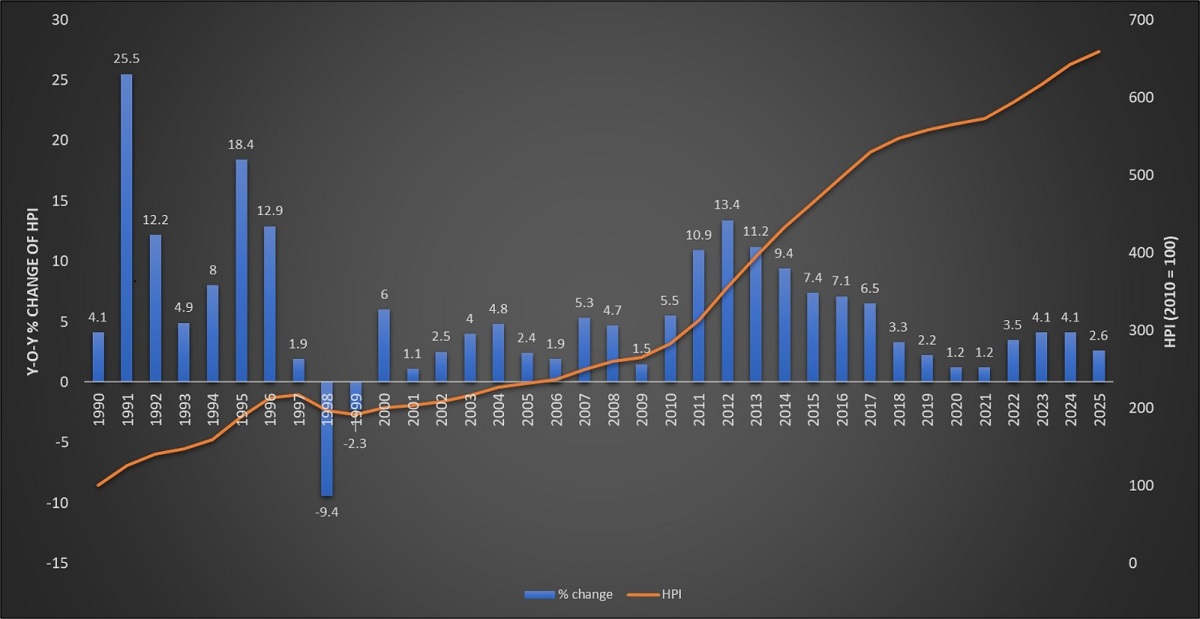
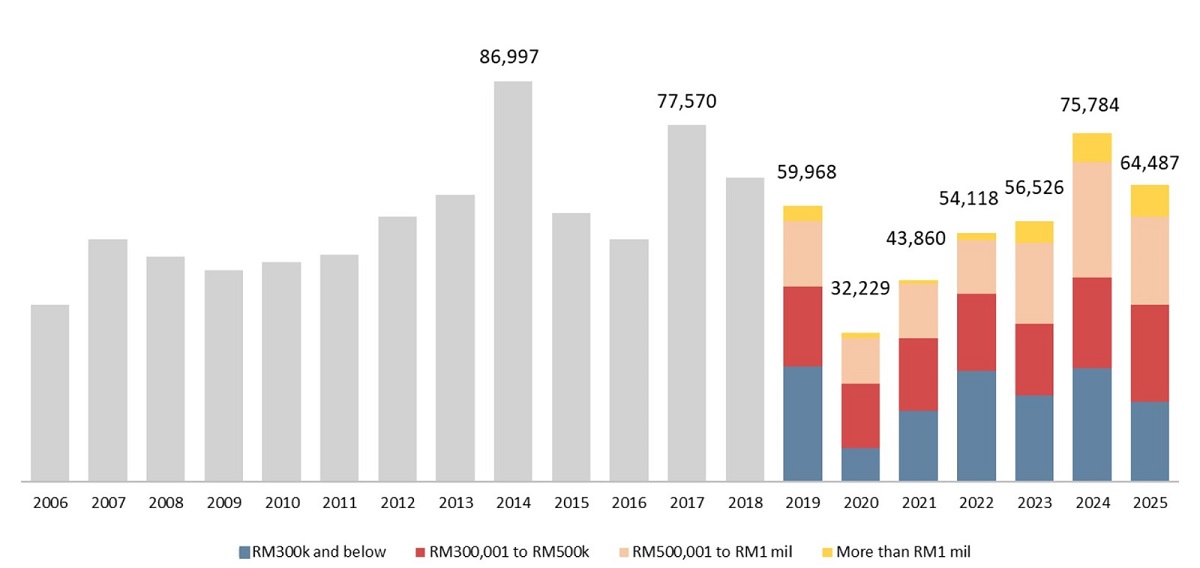
In this framework, the cycle did not begin in 2026, but in 2021, driven by a set of unprecedented conditions:
*The OPR floor at 1.75%, the lowest in Malaysia’s history
*The extension of the Home Ownership Campaign (HOC), which acted as a powerful demand catalyst
*A clear post-pandemic behavioural shift, as buyers moved to take advantage of incentives and pricing
These forces collectively reset the market.
What followed was not a gradual recovery, but a compressed surge. By 2024, the market recorded simultaneous peaks in transaction value, volume, and new launches.
From this perspective:
*2024 represents the cycle peak
*2025 marks the beginning of a correction
*2026 may sit within a mid-cycle cooling phase rather than the start of a new expansion
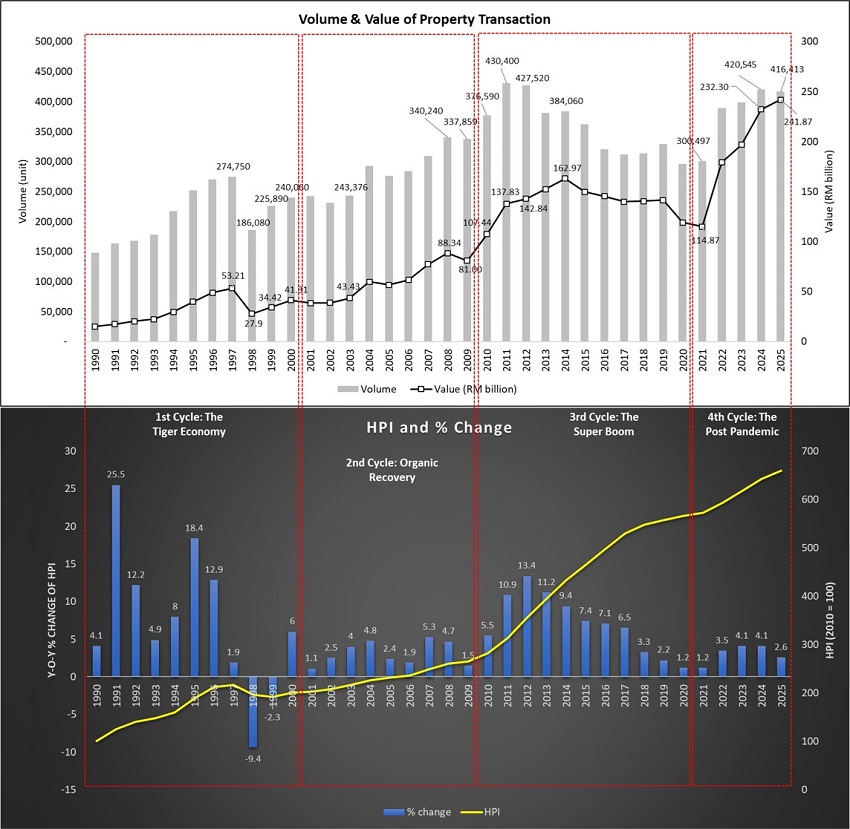
This distinction is critical, because it fundamentally changes how we interpret current opportunities.
A recurring pattern in Malaysia’s property cycles
This interpretation is not without precedent.
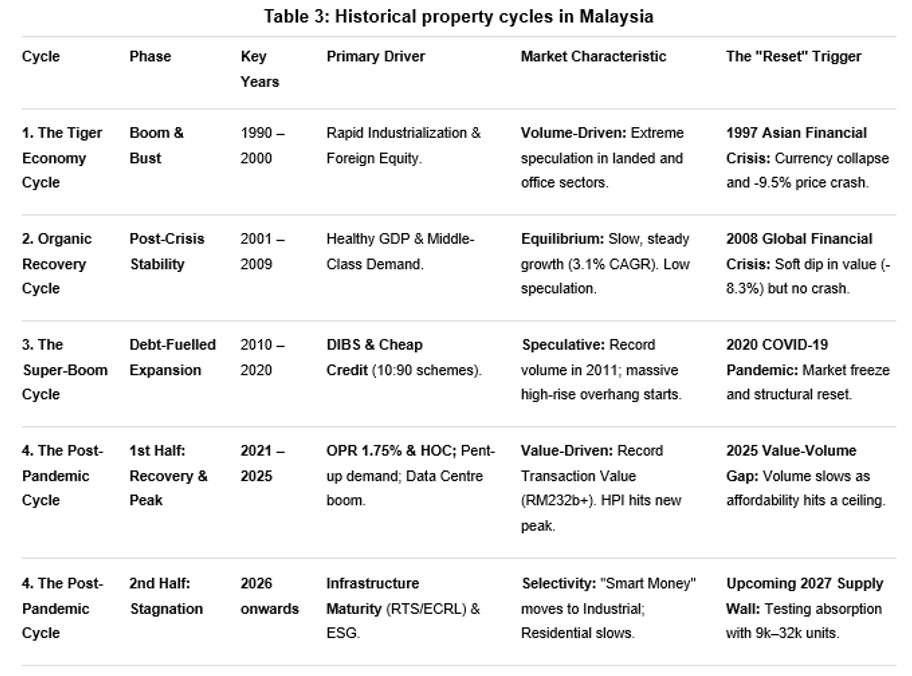
Malaysia’s property market has undergone three major cycles since 1990, each shaped by different macro drivers but exhibiting recognisable patterns:
*The 1990–2000 cycle was a classic boom-and-bust, culminating in the Asian Financial Crisis
*The 2001–2009 cycle was a period of organic recovery
*The 2010–2020 cycle was a debt-fuelled expansion
A key lesson from the Super-Boom Cycle was the danger of value-volume divergence — where prices continue rising even as transaction activity weakens.
We are seeing echoes of that pattern again today.
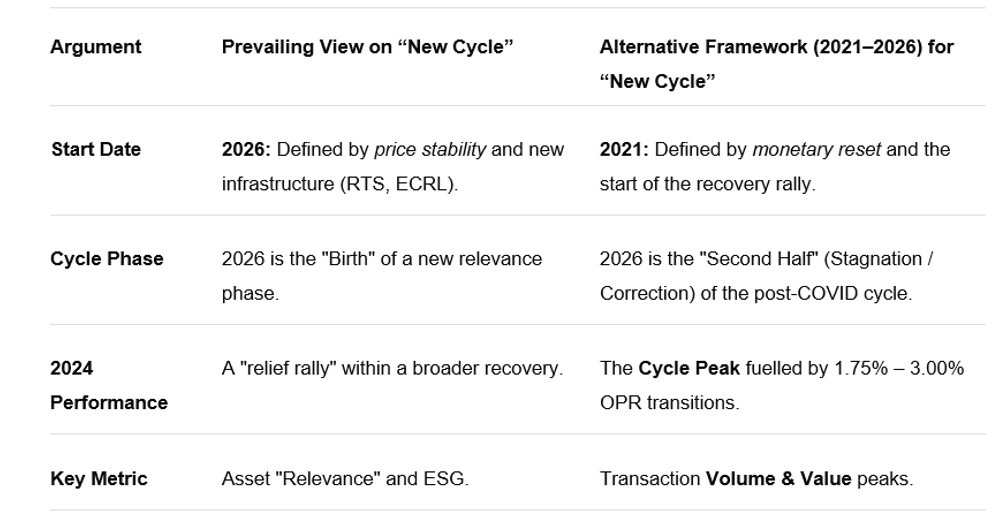
The 2021–2026 cycle: a hybrid trajectory
In my view, the current market is best understood as a hybrid cycle, beginning in 2021 and now transitioning into its second phase.
The first phase (2021–2024) was defined by:
*Liquidity-driven recovery
*Strong policy support
*A surge in both value and volume
By contrast, the emerging phase (2025 onwards) is characterised by:
*Slowing transaction volume
*Continued strength in high-value transactions, particularly in industrial and data centre assets
*A widening value-volume gap, signalling selective, rather than broad demand
This is a classic late-cycle dynamic.
It suggests that from 2026 onwards, the market’s priority will shift towards absorbing the 2024 peak supply, rather than sustaining expansion.
How developers are responding
Perhaps the clearest validation of this framework lies not in theory, but in behaviour.
Leading developers are already repositioning — not for expansion, but for resilience.
Three strategic pivots are particularly evident:
The industrial hedge
Developers such as Sime Darby Property Bhd and Mah Sing Group Bhd are increasing exposure to industrial parks and data centres
Hyper-localised relevance
A shift towards transit-oriented developments (TODs), anchored to RTS Link and MRT3
Inventory discipline
Smaller-phased launches prioritising cash flow and stock clearance
What emerges is a two-tier market — one driven by institutional and infrastructure-linked demand, and another where residential assets face increasing selectivity.
Conclusion: strategic crossroads, not starting point
In conclusion, I do not view 2026 as the beginning of a new cycle.
Rather, I see it as a strategic inflection point within a cycle that began in 2021, peaked in 2024, and is now entering a late-stage adjustment phase.
The current value-volume gap is not a sign of strength, but of market fatigue, particularly within the mass residential segment.
The window between 2026 and 2027 may represent the final opportunity to secure defensive positions before a more challenging 2027–2029 supply absorption phase.
In this environment, success will depend on asset relevance.
Capital will increasingly favour:
*Infrastructure-linked developments
*ESG-compliant industrial assets
*Logistics-driven locations
This cycle, borne out of the liquidity shock of 2021, is unlikely to complete its structural reset until 2029.
Editor’s note: This article is adapted from a longer strategy paper by Dr Foo Chee Hung. Foo holds a PhD in Urban Engineering from the University of Tokyo, and is the principal researcher of MKH Bhd.
All figures cited are sourced from the National Property Information Centre (Napic).
The views expressed are the writer’s and do not necessarily reflect EdgeProp's. It is for informational purposes only and does not constitute financial or investment advice.
..........
Get EdgeProp's inaugural monthly print edition! Free delivery is available for selected regions. Subscribe now.