Share
Share


PETALING JAYA (May 25): A private developer is seeking planning approval for a 61-storey mixed-use development in Bukit Pantai, Kuala Lumpur, in a proposal that would introduce close to 1,500 serviced apartment units into one of the capital's more established urban residential corridors.
According to a statutory public notice issued by the Datuk Bandar Kuala Lumpur on May 15, 2026 (Ref: DBKL.JPRB.1037/2022), City Hall has received an application for a proposed 61-storey mixed-use development comprising two serviced apartment blocks totalling 1,494 units and a retail podium containing 64 units.
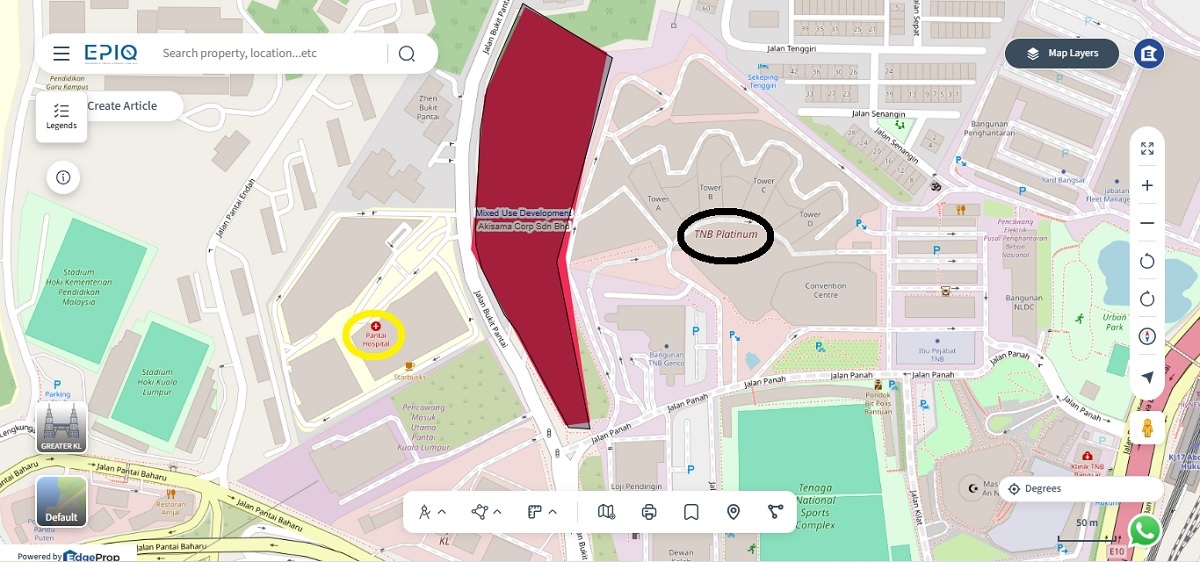
The notice states that the project is proposed for Lot 481838 and Lot PT 50296 along Jalan Bukit Pantai, and includes provisions for a pedestrian bridge and a centralised green open space.
While the official DBKL gazette notice does not explicitly identify the developer, industry data and previous planning references reviewed by EdgeProp link the proposal to Akisama Corp Sdn Bhd, a privately held property developer.
Land ownership records reviewed by EdgeProp indicate that the primary parcel, Lot 481838, is a leasehold plot registered under Akisama in May 2021 with more than 90 years remaining on its lease. The land title stipulates residential use and requires prior approval from the Federal Land Commission Committee for any transfer, mortgage or charge.
Akisama officials had not responded to queries regarding the planning application by press time.
The proposed site sits adjacent to the headquarters of Tenaga Nasional Bhd (TNB) and opposite Pantai Hospital Kuala Lumpur, placing the development footprint within a densely developed institutional and residential node in the Bangsar–Bukit Pantai corridor.
Regulatory evolution of the site
Historical planning data previously reported by The Edge Malaysia indicates that this is not the first time the parcel has attracted development interest. In January 2022, an earlier proposal was submitted to DBKL for a 70-storey mixed-use scheme on Lot 481838 comprising 1,359 serviced apartments and 61 retail units.
While the proposal received conditional approval the following month, the project did not subsequently progress into active development, based on publicly available planning records reviewed by EdgeProp.
The current application represents a revised scheme that reduces the proposed height from 70 to 61 storeys while increasing the residential component from 1,359 to 1,494 serviced apartment units. The revised application also formally incorporates the adjacent parcel, Lot PT 50296.
The notice was issued pursuant to Rule 3 of the Federal Territory (Planning) (Application for Planning Permission) (Federal Territory of Kuala Lumpur) Rules 2025 under the Federal Territory (Planning) Act 1982 (Act 267).
Under the statutory process outlined in the notice, surrounding registered landowners have a two-week window from the publication date — extending until May 29, 2026 — to submit written feedback or objections regarding the proposal to DBKL's City Planning Department.
The application comes amid continuing urban planning discussions surrounding density absorption capacity within the wider Bukit Pantai corridor, where healthcare, institutional and mixed-use developments have expanded over the past decade around Bangsar South and Pantai Dalam.
High-density residential pattern
In its Real Estate Highlights report for the first half of 2026, Knight Frank Malaysia noted that while residential demand across the Klang Valley remains active, buyers are becoming increasingly selective amid a substantial incoming housing pipeline.
The consultancy said projects supported by infrastructure readiness, local catchment depth and structural demand fundamentals continue to outperform broader market momentum-driven launches.
Knight Frank Malaysia also observed that large-scale serviced apartment developments remain prominent in areas such as Bangsar South, Bukit Jalil, KL North and Bandar Malaysia-linked precincts, reflecting continued developer interest in higher-density urban residential formats within established city locations.
The proposed density places the Bukit Pantai scheme among the larger high-rise residential projects proposed in Kuala Lumpur in recent years, based on recent planning submissions and development proposals reviewed by EdgeProp.
Corporate registry records show Akisama Corp was founded in 1979 as a construction and piling firm before expanding into property development in the Klang Valley during the 1990s. The group has previously been involved in several large-scale residential and mixed-use projects including Parklane OUG and RC Residences in Sungai Besi.
According to information published on the company's corporate website, Akisama states that it has launched a cumulative 7,779 property units across multiple Klang Valley developments over several decades, spanning serviced apartments, commercial projects and mixed-use schemes.
Project information published on the company's website indicates that much of the group's historical development footprint has been concentrated within mature Klang Valley urban corridors including Kuchai Lama, Sungai Besi, OUG and Cheras.
Infrastructure demands under review
Urban planners and infrastructure specialists have increasingly noted that projects of this scale typically require supporting infrastructure planning beyond road capacity alone, including sewerage systems, utility networks, pedestrian circulation and public transport accessibility.
Based on typical urban household assumptions and the scale of the proposed residential component, the development could potentially introduce several thousand additional residents into the immediate Jalan Bukit Pantai area upon full occupation, alongside additional vehicle movement generated by the retail podium component.
Recent development activity across Kuala Lumpur indicates that developers have increasingly pursued higher-density integrated residential formats in mature urban locations including Bukit Jalil, KL North and Bangsar South, where proximity to employment centres and transport corridors continues to support demand.
The Bukit Pantai proposal reflects a broader development pattern within Kuala Lumpur in which serviced apartments continue to form a significant component of new urban residential supply on infill land within established city neighbourhoods.
..........
EdgeProp brings you another month of data-driven insights, exclusive interviews, and market commentaries. Subscribe now for your free copy!