Share
Share


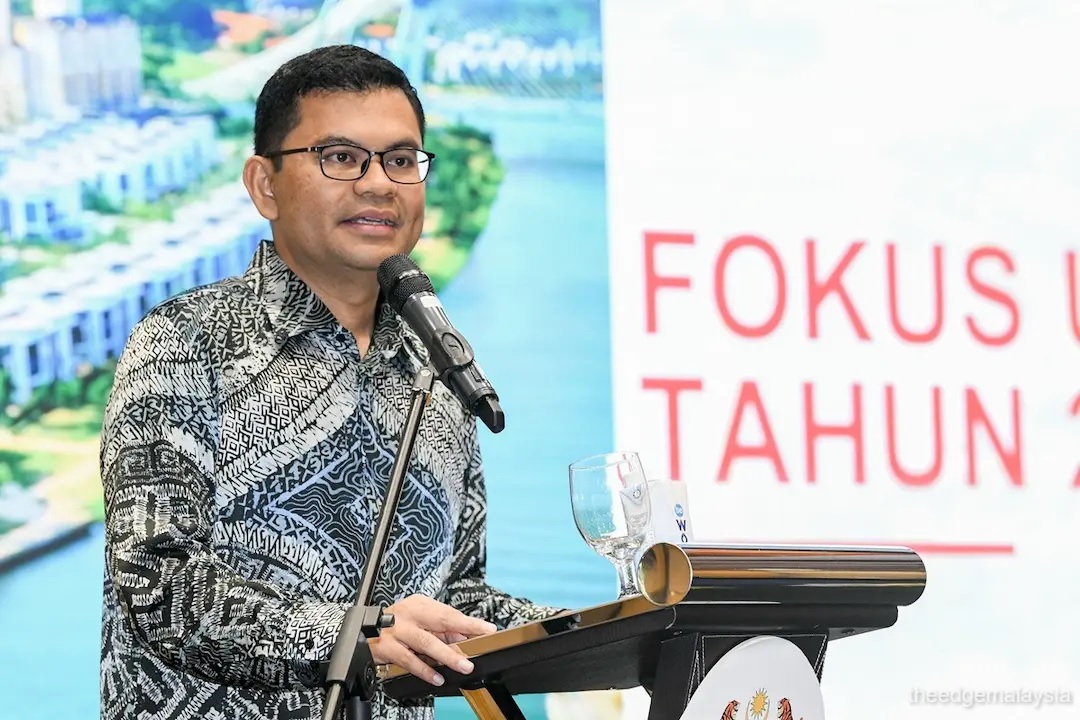
- The master plan would provide a clear and structured guide for investors while coordinating development across the zone also known as the JS-SEZ, said Economy Minister Akmal Nasrullah Mohd Nasir.
PUTRAJAYA (Jan 8): A comprehensive blueprint for the Johor-Singapore Special Economic Zone is expected to be unveiled by March, said newly-minted Economy Minister Akmal Nasrullah Mohd Nasir. (pictured)
The master plan would provide a clear and structured guide for investors while coordinating development across the zone also known as the JS-SEZ, said Akmal Nasrullah. He is scheduled to meet his Singapore counterpart by the end of this month.
In his speech at the Ministry of Economy’s January 2026 assembly on Thursday, Akmal Nasrullah said his counterpart in Singapore had requested an in-person meeting.
Speaking to reporters later, Akmal Nasrullah said preparations are under way to finalise the blueprint timeline and discussions with Singapore would begin once both sides had established a shared understanding of priorities.
“We will wait and see because I think it’s better for me to meet the minister and get the understanding between both countries,” he said when asked about the specific agenda for the meeting.
Malaysia and Singapore formally signed an agreement in January 2025 to establish the JS-SEZ, which aims to attract 100 projects worth RM100 billion within its first decade and create about 100,000 new jobs in high-value economic sectors.
The agreement was signed by Akmal Nasrullah’s predecessor Datuk Seri Mohd Rafizi Ramli and Gan Kim Yong, Singapore's deputy prime minister and minister for trade and industry.
To support the JS-SEZ, the government has announced incentives, including a special corporate tax rate, to lure investors to set up operations in the zone, which stretches from Kulai and parts of Pontian to Pengerang.
Execution in 2026
Beyond the JS-SEZ, Akmal Nasrullah said 2026 would mark a shift from policy formulation to implementation in the first of the five-year 13th Malaysia Plan.
“Every policy we design must be translated into programmes, initiatives or projects that ultimately reach the people, according to the right target groups,” he noted.
Execution would be a key performance indicator (KPI) for the ministry, Akmal Nasrullah said. “We want execution to be our shared KPI for the secretary general, deputy secretaries general, directors, heads of departments and agencies, including for myself and the deputy minister,” he said.
Effective implementation is critical at a time of a more challenging global environment, Akmal Nasrullah said, adding that monitoring would be strengthened through enhanced coordination, transparent progress reporting and faster corrective action where needed.
Further, he also underscored the importance of delivering smaller, high-impact projects alongside major initiatives, as such projects would produce faster and more visible outcomes.
“When damaged bridges, pothole-ridden rural roads, dilapidated quarters, clinics and schools are resolved quickly, people can see that the government is present to solve real issues on the ground—not merely talking about megaprojects,” he added.
Unlock Malaysia’s shifting industrial map. Track where new housing is emerging as talents converge around I4.0 industrial parks across Peninsular Malaysia. Download the Industrial Special Report now.