Share
Share


PETALING JAYA (Jan 15): Malaysia’s economy is near its potential, supported by stable monetary policy and gradual fiscal consolidation, signalling steady conditions despite external uncertainties.
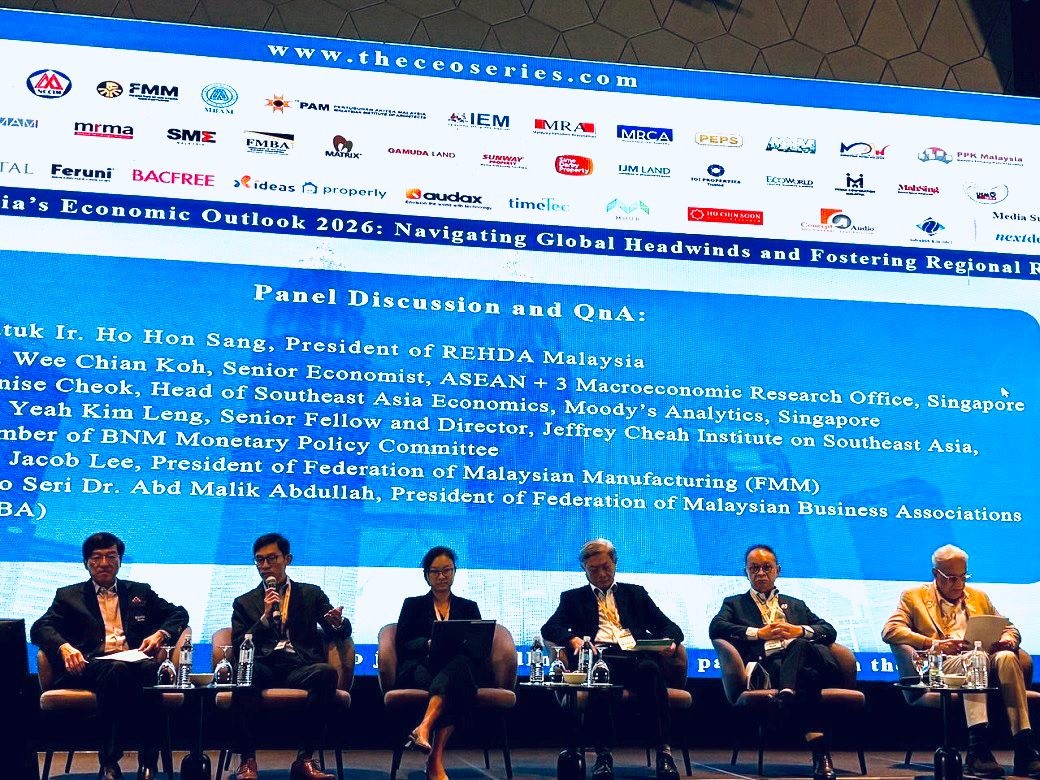
This was noted during the Real Estate and Housing Developers' Association (Rehda) Institute’s flagship CEO Series 2026, which brought together over 400 senior decision-makers from government, finance, industry, academia, and the international business community to discuss Malaysia and Asean’s economic outlook, investment priorities, and human capital challenges.
A key highlight of the conference was the launch of the Rehda Institute Youth Initiative (Riyi), a national human capital development programme that brought together more than 13 universities nationwide alongside corporate leaders and industry practitioners to provide structured mentorship, early industry exposure, and career guidance for high-potential students.
Jeffrey Cheah Institute on Southeast Asia senior fellow and director Yeah Kim Leng said Malaysia’s monetary policy has so far navigated both domestic and external challenges effectively.
“Financial and monetary stability is a core mandate of the central bank. Post-pandemic growth has caught up with pre Covid-19 levels, with the recovery described as relatively sharp, and supported by strong financial institutions,” he said during the “Asean and Malaysia’s Economic Outlook 2026: Navigating Global Headwinds and Fostering Regional Resilience” panel session at Le Méridien Petaling Jaya today.
He added that much of this recovery is due to financial stability, sufficient credit flows, and a balance between savings and investment.
“A stable monetary policy framework has strengthened investor and consumer confidence while helping to moderate external shocks, particularly to the financial system.
“Monetary adjustments have been gradual, providing stability for savings, private sector investment, and government planning,” he said.
Yeah said the key priority remains ensuring price stability while sustaining growth, noting that economic performance has exceeded expectations.
“Growth last year was above expectations, and 2025 is likely to approach 5%, based on third-quarter growth of 5.2% and 4.7% growth over the first three quarters,” he said.
He also stated that low inflation has provided both monetary and fiscal space should global economic conditions deteriorate, while current growth levels suggest a neutral monetary policy stance.
“Growth is now close to its potential level,” Yeah stated.
JS-SEZ should create higher-scale jobs
Singapore strategic management advisory firm Bradshaw & Mitchell managing director Prakash Nagarajan highlighted two key components for the Johor–Singapore Special Economic Zone’s (JS-SEZ) success, with the first being an efficient business ecosystem.
“It is pointless to create economic zones while continuing with old practices. There has been steadfast commitment from the Johor state government and the federal government, but the proof is in the pudding.
“It’s not just about having policies, but ensuring that the machinery on the ground lives up to expectations. There is some way to go, but this is a key ingredient,” he said during the Special Focus Session on Johor–Singapore and JS-SEZ panel session.
Prakash said the second component is looking at things from a different perspective, particularly the type of jobs created.
“Historically, Johor has been seen as a low-cost manufacturing centre, but that has evolved. Along with development, there needs to be higher-tier job creation with better salaries to retain talent,” he added.
RTS Link and Bukit Chagar development on track
Meanwhile, the government remains optimistic that the Johor Bahru (JB)–Singapore Rapid Transit System (RTS) Link project will be fully completed by December this year, ahead of its opening to passengers in January 2027. Construction of the physical infrastructure is nearly complete, while system installation and comprehensive testing are underway to ensure safety and smooth operations.
Transport Minister Anthony Loke Siew Fook said the project is progressing on schedule, with critical components such as train operations and station systems currently being installed.
“This testing phase is crucial because without thorough trials, the RTS cannot operate. In JB, trains are already being tested on the tracks,” he told the press at the event.
Loke also highlighted plans to implement a “co-location” concept for the Customs, Immigration, and Quarantine (CIQ) complex, placing Malaysian immigration officers in Woodlands and their Singaporean counterparts at Bukit Chagar Station.
On Bukit Chagar’s development, he added that the government is inspired by transit-oriented development (TOD) models like those in Hong Kong, encouraging building owners to collaborate for better connectivity and pedestrian access.
Unlock Malaysia’s shifting industrial map. Track where new housing is emerging as talents converge around I4.0 industrial parks across Peninsular Malaysia. Download the Industrial Special Report now.