Share
Share


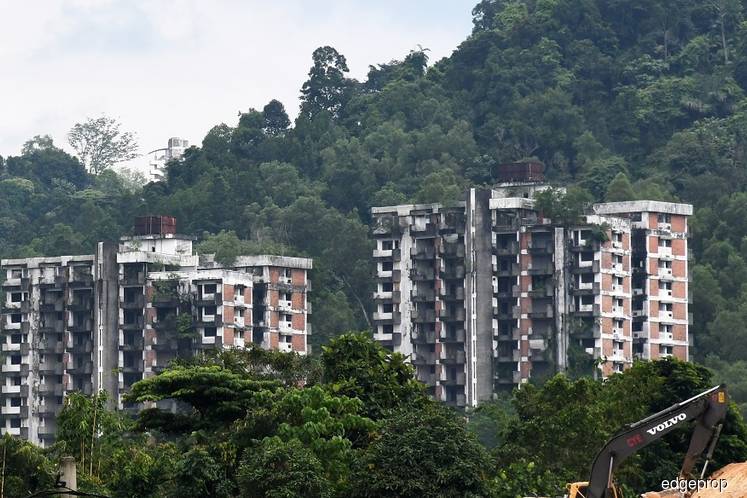
When discussing high-risk residential zones, it is important to clarify what the term truly encompasses.
Such areas commonly include flood-prone neighbourhoods, hillsides vulnerable to landslides, and land built over limestone formations susceptible to sinkholes.
They also cover locations near geological fault lines or unstable soil conditions, as well as developments situated beside gas pipelines, electrical substations, reservoirs, industrial facilities or chemical plants.
Homes along forest fringes face heightened fire risks, while properties constructed beneath or close to high-voltage transmission lines carry their own safety concerns.
Despite these very real dangers, most buyers are unaware that they are purchasing property within such zones.
Take hillside developments as an example.
Homeowners are not issued certificates confirming that slopes are safe in both design and final construction.
Instead, buyers rely on the assumption that approvals granted by professionals and authorities are sufficient.
To the untrained eye, a reinforced slope appears stable—until the moment it fails.
Lessons we failed to learn
The collapse of Highland Towers should have permanently reshaped how residential safety is treated in Malaysia. Thirty years ago, 48 lives were lost in a landslide triggered by heavy rainfall, poor drainage and fundamental design failures.
Yet decades later, there remains no real sense of closure or accountability. More troubling is that the tragedy was not an isolated incident.
Across the country, similar warnings have surfaced repeatedly. In Taman Bukit Permai, slope instability and landslides have placed residents at risk.
In Taman Sri Muda, recurring floods continue to devastate communities.
Cameron Highlands has experienced destructive mudflows linked to overdevelopment, while rapid urbanisation over limestone formations in Puchong and Rawang has resulted in sinkholes.
In each case, approvals were granted, early warnings were overlooked and ordinary residents ultimately bore the consequences.
What must change to prevent future disasters
More than a decade ago, at a national slope management seminar attended by senior officials, engineers and planners, a critical question was raised: have we done enough to protect homeowners? The honest answer remains no.
Key resolutions were agreed upon at the time. These included simplifying and strengthening hill-site development guidelines, mandating independent and accredited geotechnical checkers, and enforcing stricter penalties against negligent developers and slope owners.

There was consensus on establishing comprehensive slope inventories, gazetting them under existing laws and ensuring slope designs are reviewed beyond individual project boundaries rather than in isolation.
Major earthworks and slope stabilisation were meant to be completed before building works commenced, followed by regular professional inspections of high-risk slopes.
Maintenance manuals for engineered slopes, community monitoring groups working alongside local authorities, and the creation of a centralised geotechnical body modelled after Hong Kong’s system were also recommended.
Implementation, however, has been uneven at best.
Shared responsibility for housing safety
Residential safety must be treated as a shared responsibility. Developers are obligated to conduct proper ground investigations and implement appropriate mitigation measures.
Local councils must have the resolve to reject unsafe proposals outright rather than approving them with conditions that are never enforced.
Government agencies should disclose risk maps transparently so buyers can make informed decisions.
At the same time, prospective homeowners must be equipped with accurate information and encouraged to walk away from developments that may be visually appealing but structurally dangerous.
Some projects, however attractive, are little more than beautiful disasters waiting to happen.
The problem with impact assessments
One of the most significant gaps in the current system is the inaccessibility of environmental, social and traffic impact assessments.
These documents are typically submitted only to local authorities and are not made available to buyers, even though they directly affect personal safety and long-term financial security.
Many of these assessments are commissioned by developers themselves, raising legitimate concerns about independence.
There have been instances where traffic impact studies concluded congestion would not occur in areas already notorious for severe gridlock.
Yet when disasters strike, blame is often shifted to buyers, with arguments that consumer demand fuels risky development.
That position is fundamentally flawed. Buyers have a right to expect safe and sound construction, regardless of location.
Accountability remains the missing piece
Partial reforms have been introduced, but they remain inconsistent.
Measures such as mandatory risk disclosures, stricter enforcement, early warning systems, periodic inspections, insurance mechanisms and climate-resilient planning are widely discussed.
However, persistent legal and regulatory weaknesses continue to undermine progress.
These include poor monitoring by local authorities, weak enforcement of slope and drainage master plans, inconsistent application of planning laws and approvals granted without robust or genuinely independent impact assessments.
Until accountability becomes real rather than theoretical, collaboration alone will not suffice.
Why buyers remain exposed
Structured safety briefings or formal checklists during the handover process could significantly reduce buyer risk, yet such measures are largely absent.
Buyers should be able to obtain clear answers to basic questions: whether a home complies with planning norms, whether it sits within a designated risk zone, what mitigation works were carried out and by whom, whether insurers have raised concerns, and what historical incidents have occurred in the vicinity.
Without mandatory disclosure, buyers remain dangerously exposed.
Purchasing the wrong house in the wrong location can leave homeowners financially vulnerable long before their mortgage is paid off.
Closing reflection
Residential safety is not a luxury. It is a non-negotiable right. Until transparency, enforcement and accountability become standard practice, many Malaysians will continue living on the edge—often without fully realising how close they are to falling.
This article is written by Datuk Chang Kim Loong, honorary secretary-general of the National House Buyers Association (HBA).
HBA is a voluntary non-government and not-for-profit organisation manned wholly by volunteers.
HBA can be contacted at:
Email: [email protected]
Website: www.hba.org.my
Tel: +6012 334 5676
The views expressed are the writer's and do not necessarily reflect EdgeProp’s.
..........
Unlock Malaysia’s shifting industrial map. Track where new housing is emerging as talents converge around I4.0 industrial parks across Peninsular Malaysia. Download the Industrial Special Report now.
.jpeg?Dc.IvzT0vI55UUTaKxAW9caca44P99nz)