Share
Share


This article appeared in the April 9, 2026 issue of the monthly print edition. Subscribe now.
The Klang Valley’s residential landscape is undergoing a structural shift, with high-rise developments forming an increasing share of new housing supply, particularly within the mid-market segment.
For many urban households looking to upgrade, the traditional progression towards landed homes within city locations is becoming increasingly difficult because of rising costs, limited land availability, and development constraints.
As a result, high-rise developments are emerging as a more accessible option for those seeking better locations and improved living environments.
This shift is reflected in the growing pipeline of mid-market high-rise projects across key locations, offering a range of unit types including larger, family-oriented layouts that cater to evolving upgrader needs.
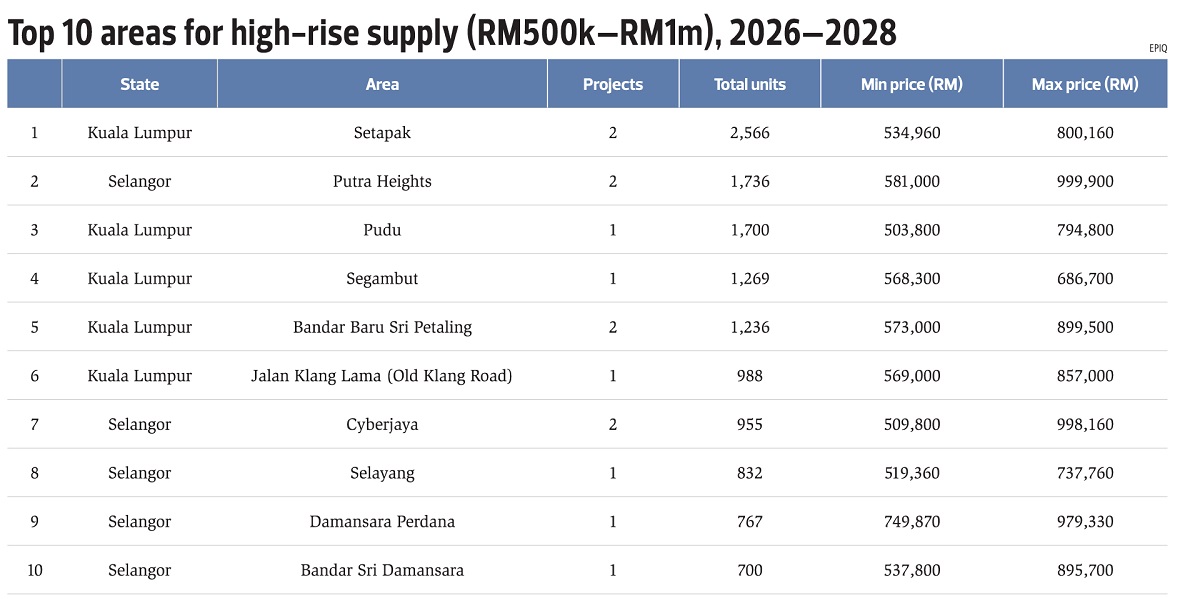
EdgeProp’s EPIQ data has identified 30 upcoming non-landed residential projects priced RM500,000–RM1 million scheduled for completion between 2026 and 2028.
The concentration of supply within this price band highlights where both developers and buyers are currently aligned.
Why Klang Valley remains the focal point
The Klang Valley continues to anchor residential demand because of its position as Malaysia’s primary economic and employment hub.
According to Henry Butcher Malaysia director of corporate real estate Long Shi Chuen, there are generally two dominant buyer groups in the urban high-rise segment: investors and owner-occupiers. For the latter, demand is driven primarily by singles, professionals, couples, and small families.
“High-rise living in urban areas offers proximity to workplaces, amenities, and public transport, making it a practical and attractive option,” he says.
Hence, this concentration of employment, infrastructure, and established conveniences continues to sustain housing demand.
Mid-market price bracket reflects upgrader demand
The RM500,000–RM1 million price range reflects where a significant portion of urban buyers, particularly upgraders, are positioned in terms of affordability.
JLL Malaysia managing director Jamie Tan states that many mid-level executives and professionals aged between 28 and 40 are targeting homes priced between RM400,000 and RM600,000.
Similarly, PropNex Malaysia chief operating officer Evon Heng notes that the most active transaction band across key markets remains between RM500,000 and RM900,000, as it aligns with dual-income household affordability, and suits both first-time buyers and upgraders.
Within this context, the clustering of new supply in the RM500,000–RM1 million range reflects how developers are positioning projects to meet the financial capacity of this buyer segment, while still offering upgraded living environments compared to entry-level housing.
Key locations offering upgrader-friendly options
The data highlights several areas across Kuala Lumpur and Selangor where upcoming highrise supply is concentrated, particularly within established urban and city-fringe locations.
Setapak leads with 2,566 units across Residensi M Astra and Residensi M Azura by Mah Sing Group Bhd, followed by Putra Heights (1,736 units), and Pudu (1,700 units). Other notable areas include Segambut, Bandar Baru Sri Petaling, Jalan Klang Lama, Cyberjaya, Selayang, Damansara Perdana, and Bandar Sri Damansara.
Across these locations, upcoming developments typically offer a mix of unit configurations, including a growing number of practical 3-bedroom layouts catering to families and mid-income upgraders. This makes these locations particularly relevant for upgraders seeking larger, more functional units within well-connected urban environments.
Connectivity and amenities main considerations
These locations share several common characteristics that support residential demand.
First, many are located within or near established employment corridors, allowing residents to remain within commuting distance of key job centres such as KL city centre, Petaling Jaya, and Subang.
Second, they are supported by existing transport infrastructure, including MRT and LRT lines as well as major highways.
Tan notes that developments located near MRT or LRT stations benefit from planning advantages such as higher plot ratios, while also supporting demand due to improved accessibility.
Third, these areas are generally supported by established amenities, including retail, healthcare, and education facilities, which are key considerations for owner-occupiers.
For upgraders, the ability to balance housing affordability with proximity to workplaces, transport networks, and daily amenities remains a key consideration when selecting a home. These factors collectively reinforce why high-rise developments in these locations continue to attract demand.
Three-bedroom units favoured
Across the identified hotspots, upcoming developments typically offer a mix of unit configurations, ranging from smaller layouts to larger formats.
Heng notes that while supply in many locations has been skewed towards smaller, investor-focused units, there is growing demand for 3-bedroom configurations.
“Young families are increasingly choosing vertical living near transport and schools, with a preference for practical layouts,” she says.
This is reflected in several upcoming projects within the dataset.
In Bandar Baru Sri Petaling, Aster Hill Residences by UOA Development Bhd offers 3-bedroom layouts suited for family living. Along Old Klang Road, Radium Arena by Radium Development Bhd includes a mix of 2- and 3-bedroom units, including dual-key configurations.
In Damansara Perdana, D’Terra Residences @ Central Park Damansara by Exsim Development Sdn Bhd features 3- and 3+1-bedroom layouts. In Cyberjaya, Lakefront Residence (Phase 4) by Avaland Bhd also forms part of the broader pipeline offering larger-format units within a suburban growth corridor.
The availability of such layouts indicates how some developments are being positioned to meet the needs of upgraders who require more functional living space within high-rise environments.
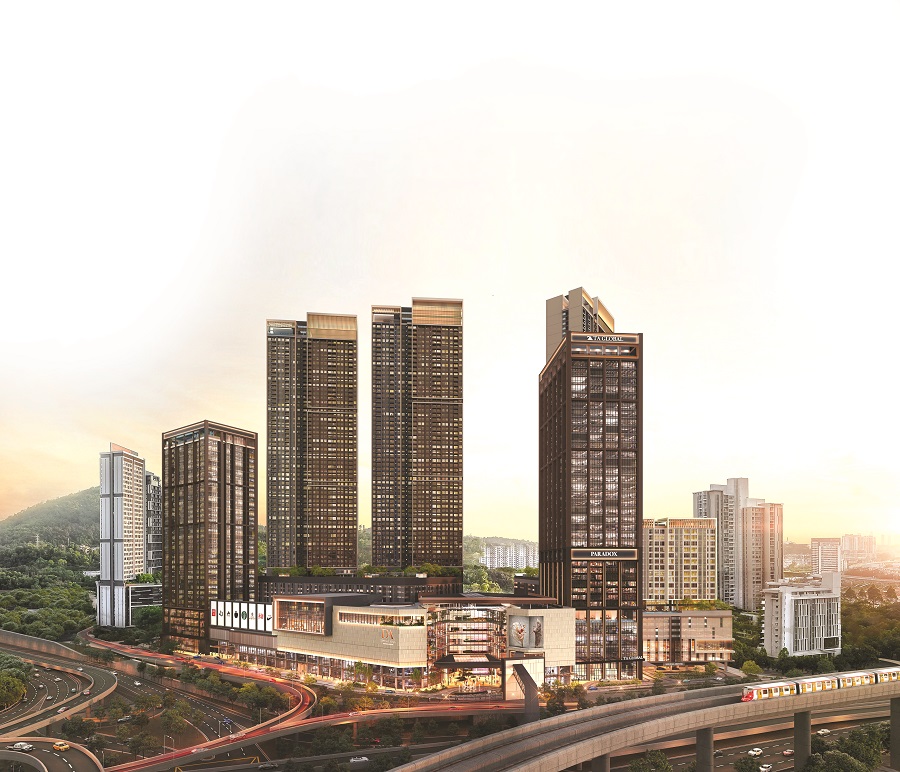
Upgraders adjust to vertical living
As high-rise supply expands, upgrader behaviour is evolving in response to market conditions.
With landed homes in urban locations becoming increasingly difficult to access because of pricing constraints, some buyers are shifting towards high-rise developments that offer better location advantages and access to infrastructure.
According to Long, high-rise developments provide a more accessible entry point into homeownership because of their lower absolute prices compared to landed properties, particularly within urban areas where land is limited and costly.
This shift is observed among working professionals and families who prioritise proximity to workplaces and amenities, as well as among households seeking more manageable living arrangements within urban environments.
COST PRESSURES PUSH BUILDINGS UPWARDS
Land scarcity remains a fundamental constraint shaping development trends in urban areas.
JLL Malaysia managing director Jamie Tan explains that available land within Kuala Lumpur continues to diminish, while high costs in land acquisition and approval require developers to optimise land use through higher-density projects.
He adds that affordability also plays a role.
“For the M40 group, their budget is probably around RM500,000. In an urban setting, it is unlikely that a developer will be able to build landed homes to be sold at those prices,” he says.
Rising construction costs further influence development decisions, as lower-density projects may not generate sufficient returns to justify investment.
Henry Butcher Malaysia corporate real estate director Long Shi Chuen adds that scale is a key consideration in property development.
“The only practical way to increase unit numbers is to build upwards,” he says, noting that higher-density developments allow developers to maximise the number of units within planning constraints while optimising pricing strategies.
Looking ahead, Tan points out that besides focusing on developments that are well positioned in terms of location and pricing, there may also be opportunities to repurpose underutilised commercial buildings into residential units.
This article has been updated to reflect greater accuracy.
..........
EdgeProp's monthly print edition is out! Free delivery is available for selected regions. Subscribe now.