Share
Share


KOTA KEMUNING (Jan 28): Datuk Low Boon An founded Ancubic Group of Companies in 2011, and nearly every aspect of the business was managed personally by him then.
Today, the property development company has evolved into a forward-looking, ecosystem-driven developer with a long-term vision that integrates lifestyle, wellness, and industrial development.
“At that stage, leadership meant only one thing: act fast, make accurate decisions, and bear the risks personally,” he shared in an exclusive interview with EdgeProp.
In 2011, he officially led the company into property development, beginning with its first landmark project—KS Botanic, a mixed-use development in Kuala Selangor with a gross development value (GDV) of RM80 million, completed in November 2014.
This was followed by Suria Jaya E-SoFo in Shah Alam, Selangor, a 22-storey commercial development with a GDV of RM160 million, completed in April 2017.
In 2016, the group launched Kazen I & II at Taman Saujana Puchong, Selangor, a three-storey terrace housing development with a GDV of RM40 million. The project garnered multiple awards and was completed in January 2018.
A hands-on beginning
In the early years, the business relied heavily on hands-on leadership. From land negotiations and bank financing approvals to site supervision, financial management, and agent coordination, Low was the company’s primary executor. Spending long hours on construction sites ensured build quality while allowing him to resolve complex issues swiftly.
“In the early days of entrepreneurship, everything had to be built from scratch,” said Low, who currently serves as group managing director.
Building the team
By 2017, as Ancubic grew, Low recognised that scaling the business required a shift in leadership approach. His focus transitioned towards people, systems, and empowerment.
The group then ventured into high-rise developments, launching Cubic Botanical, a mixed-use project in Pantai Dalam, Kuala Lumpur, with a GDV of RM700 million, completed in May 2023. During the same period, Ancubic expanded into industrial properties, and officially entered the Penang market in 2024.
“I began focusing on building teams and systems. Some people adapt within three months, others take three years. We must be patient,” Low said.
To him, teams matter more than individuals. Through discipline and patience, he prefers investing in talent development rather than pursuing short-term gains. Every new employee is nurtured as a core member of the organisation—a structure that allows Ancubic to grow sustainably while remaining innovative and agile.
“Culture is more important than systems,” he emphasised.
Ancubic places greater priority on shared values, teamwork and accountability than rigid processes. He especially values young leaders with strong self-motivation, adaptability and problem-solving capabilities.
Low practises what he calls the “Triangle Balance Principle”: values, trust and sustainable partnerships.
“Only when employees are genuinely happy will customers feel the warmth, and partners will be willing to walk the long journey with us,” he said.
A lifestyle-centric development vision
Ancubic’s evolution has gone well beyond conventional property development.
Plant-themed townships, health and sports facilities, as well as integrated ecosystems combining industrial, commercial and residential components have become the group’s core positioning. This philosophy is reflected in multiple projects, including A-Park Bangi, Ancubic Harmoni City (Telok Panglima Garang), CG New Town (Bukit Tinggi commercial park), A-Park Batu Kawan (Penang industrial park), A-Park Bangi (industrial park), and Rosedale (Klang residential and commercial development).
Cubic Botanical integrates greenery seamlessly into architectural design. Kazen, a three-storey terrace housing project with built-up areas of approximately 2,383 sq ft and prices ranging from RM750,000 to RM820,000, demonstrates how thoughtful design can create high value within compact spaces. Meanwhile, Suria Jaya, a boutique SoHo project, highlights the importance of proximity to transportation hubs.
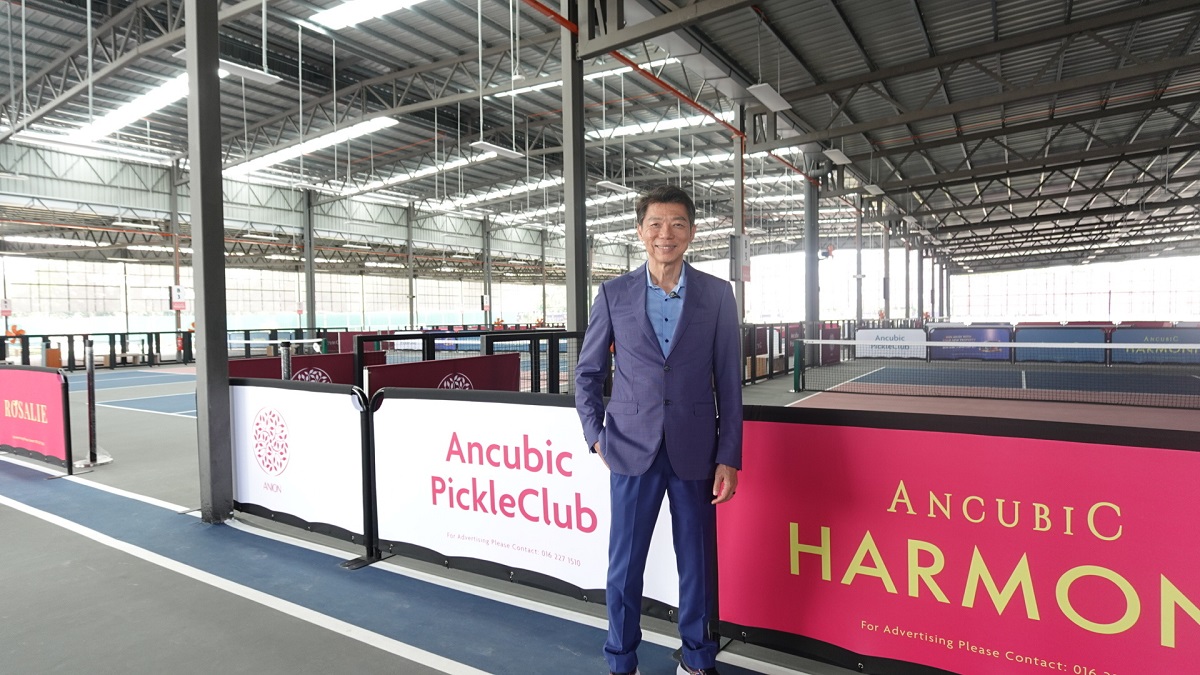
Within Ancubic Harmoni City, the group has developed a standalone pickleball facility for the community. Ongoing upgrades include the introduction of overseas technology to reduce court heat and enhance playing comfort. The facility offers a special membership package at RM99 for seven sessions, valid for three months. Users may also enjoy promotions via the AFA mobile application using a promotional code.
Industrial parks as ecosystems
“In recent years, we have shifted from ‘building a structure’ to ‘creating a lifestyle’, or an extended industrial park development model,” Low said.
These parks are designed around a cluster-based concept, incorporating mixed-use elements to enhance efficiency, collaboration and security, while increasing attractiveness to international investors.
At Ancubic, “lifestyle” extends beyond residential developments. Even industrial parks are planned as integrated ecosystems where work, wellness, and community coexist.
“Harmoni City, Cubic Botanical, A-Park Batu Kawan, A-Park Bangi, and Rosedale are all carefully selected based on accessibility, proximity to industries and commercial hubs, and long-term community growth potential,” he explained.
For instance, within a 5km radius of A-Park Batu Kawan, there are approximately 150 multinational corporations (MNCs); while A-Park Bangi is surrounded by around 26 MNCs, including Intel, Sony, Panasonic, Bosch and Honda. Proximity to these corporations makes the parks highly attractive to tenants—enabling closer access to customers and partners, shorter commuting times, and stronger industrial networks.
“In the past, many high-tech international companies were my clients. Today, I have brought them into our industrial parks,” Low elaborated.
He also shared that exposure to property developments in advanced countries such as Japan—known for their aesthetics, precision and long-term value creation—has profoundly shaped his perspective. Upon returning to Malaysia, he was determined to introduce those high standards into the local property market.
Diversification and growth
Ancubic’s current portfolio remains well-balanced: 35% industrial, 25% commercial, and 40% residential.
Ancubic Harmoni City spans 33 acres and forms part of the group’s six ongoing developments, which include CG New Town, A-Park Batu Kawan, A-Park Bangi, Rosedale, and two additional residential and industrial projects under planning. The total combined GDV is estimated at RM2.25 billion.
“Looking ahead, the company is exploring retail developments such as neighbourhood malls, or integrated commercial hubs to generate recurring income,” he said, adding that approximately RM600 million in GDV is expected in 2026.
The group continues to acquire land banks in the Klang Valley and Penang, while also exploring industrial and residential opportunities in Johor, and Negeri Sembilan.
Low remains highly selective in land and project acquisitions, focusing on location, logistics, ESG (environmental, social and governance) standards, and future ecosystem potential. Prior to any investment decision, he thoroughly evaluates land use, operational requirements, and long-term sustainability.
Its industrial park sizes range from 20 acres to 200 acres, with scale determining the types of industries accommodated—from light and medium to heavy industries. Larger land parcels enable more complex master planning, phased development, and refined resource allocation.
“Over the next decade, Malaysia’s commercial and lifestyle-integrated developments will continue evolving towards more holistic, lifestyle-centric township planning,” he concluded.
Unlock Malaysia’s shifting industrial map. Track where new housing is emerging as talents converge around I4.0 industrial parks across Peninsular Malaysia. Download the Industrial Special Report now.