Share
Share


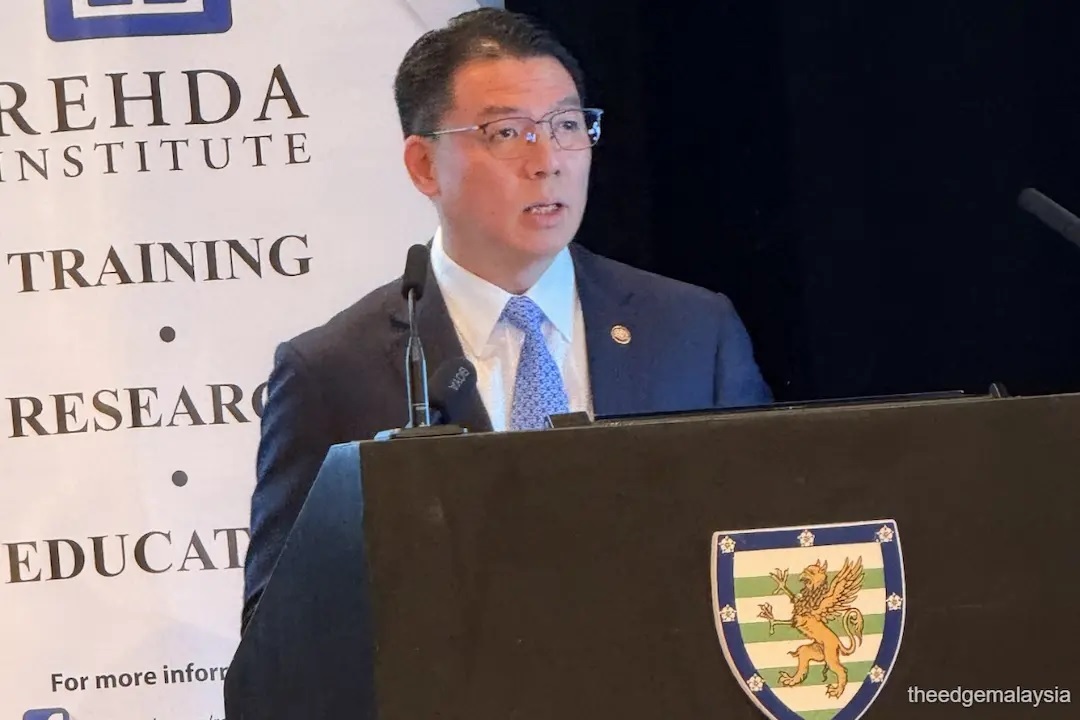
LONDON (March 26): Malaysia is not immune to rising housing affordability pressures despite its relatively high homeownership rate, Housing and Local Government Minister Nga Kor Ming said, as the government shifts towards more targeted and data-driven housing reforms.
Speaking at Downing College, University of Cambridge, in the UK on Tuesday, Nga said that while about 76.5% of Malaysians own homes, affordability challenges are becoming more pronounced, particularly among bottom 40% and middle 40% income groups.
“We are not immune to the universal pressures of affordability, particularly for our B40 and M40 communities,” said Nga.
He added that Malaysia is moving away from broad-based housing policies towards a more calibrated approach, where prices are benchmarked against local income levels rather than market forces alone.
“We have moved beyond the era of reactive crisis management. Instead, we are building a proactive, data-driven ecosystem that anticipates the needs of our citizens decades into the future,” he said, adding that Malaysia’s housing strategy is increasingly focused on long-term liveability, including better integration of land use, infrastructure and planning, as well as climate resilience.
The speech marked the culmination of the Asia Real Estate Leaders (AREL) study tour to the UK, organised by Rehda Institute, which brought Malaysian policymakers and industry leaders to engage with global experts on urban regeneration, transit-oriented developments and alternative housing models.
Meanwhile, the minister said that the government is looking to deepen collaboration with leading global institutions, including efforts to attract Malaysian talent trained abroad.
“My mission is to bring top talent back to Malaysia. We are offering internship programmes so they can gain firsthand experience and better understand how the ministry operates,” he said.
In a panel session, MKH Bhd (KL:MKH) group managing director and Rehda Institute trustee Tan Sri Eddy Chen said the affordability challenge is increasingly concentrated among the middle-income segment as structural costs within the housing system continue to rise.
“The perception is that the B40 is growing and the M40 is shrinking...it is perhaps the M40 that we should look at,” he said, citing figures based on Rehda Institute and Universiti Malaya’s research that homeownership of the B40 (76.3%) exceeded that of the M40 (75.9%) in 2024.
Chen said Malaysia’s public-private housing model has enabled large-scale supply and high homeownership, but rising compliance costs, infrastructure contributions and regulatory requirements are pushing up development costs.
“All this has created distortion,” he said, referring to price controls and cross-subsidy mechanisms imposed on developers.
He added that ongoing geopolitical tensions and rising input costs are likely to further pressure affordability in the near term.
Separately, Rehda Institute chairman Datuk Jeffrey Ng Tiong Lip said the study tour was aimed at translating global best practices into practical strategies for Malaysia’s evolving urban landscape.
“As our urban landscapes continue to evolve in complexity, it is essential for industry stakeholders to translate these learnings into practical strategies that support more resilient, liveable and strategically developed cities,” he said.
The discussions in Cambridge and the AREL study tour underscore a growing recognition that Malaysia’s housing model must evolve beyond a supply-driven approach towards one that better balances affordability, sustainability and structural constraints.
..........
EdgeProp's inaugural monthly print edition is fresh off the press! Free delivery is available for selected regions. Subscribe now.
.jpeg?Dc.IvzT0vI55UUTaKxAW9caca44P99nz)