Share
Share


PETALING JAYA (Aug 14): Government policy, infrastructure investment and digitalisation are increasingly shaping Southeast Asia’s real estate markets, as capital and occupier demand shift towards new economic corridors, industrial platforms and digital infrastructure hubs, according to JLL.
In its latest regional report, Planning for a Multipolar World: Real Estate Strategies Across Southeast Asia in 2026 and Beyond, the global property consultancy said the region was moving beyond a broadly based cyclical recovery into a more selective phase driven by geopolitical fragmentation, supply-chain diversification, state-led infrastructure spending and rising sustainability standards.
Within that framework, Malaysia stands out through the Johor-Singapore Special Economic Zone (JS-SEZ), Johor’s growing data centre ecosystem, Greater Kuala Lumpur’s expanding industrial catchment and Penang’s role in high-value manufacturing.
“Malaysia exemplifies the shift we’re seeing across Southeast Asia — from single-city concentration to networked, corridor-led growth,” said JLL Southeast Asia head of research and advisory Dr Chua Yang Liang.
“The Johor-Singapore axis represents not just cross-border cooperation but a fundamental reimagining of how economic activity can be distributed across interconnected systems.”
Policy becomes a market signal
JLL said public policy had become an increasingly important indicator of where future real estate demand could be concentrated, as Southeast Asian governments moved beyond supporting market growth to actively directing it.
The report cited Malaysia’s rollout of three major special economic zones alongside Indonesia’s Danantara sovereign wealth platform, the Philippines’ extension of investor land leases to 99 years, Vietnam’s institutional reforms and Singapore’s artificial intelligence and sustainability strategies.
For investors, this means market prospects are increasingly influenced by incentives, infrastructure sequencing, industrial policies and land-use reform, rather than solely by conventional indicators such as rental growth, available supply and capitalisation rates.
Malaysia’s most prominent example is the JS-SEZ, which JLL identified as a key policy-led growth corridor with implications for real estate demand on both sides of the border.
JLL Malaysia head of research and advisory Yulia Nikulicheva said the country’s investment incentives, utilities network, skilled labour, land-title system and legal framework supported its appeal to international companies seeking long-term investments and greater geographical diversification.
Malaysia’s diversified economy also allowed it to appeal to companies from a broad range of industries and regions considering expansion into Southeast Asia, she said.
Infrastructure redraws the property map
Transport and utilities investment are widening the range of locations considered viable for industrial, logistics, office and mixed-use development, JLL said.
The report argued that accessibility was becoming more important than historical centrality in determining real estate value, as new rail links, ports, airports and cross-border connections elevated secondary nodes beyond traditional central business districts.
The Johor-Singapore axis is the region’s most prominent cross-border example. On the Singapore side, Woodlands North is expected to become increasingly important not only as part of the city-state’s decentralisation strategy but also as the northern gateway to its developing economic relationship with Johor.
On the Malaysian side, the JS-SEZ could allow economic functions to be distributed according to the relative strengths of both markets, potentially influencing the location of manufacturing, logistics, commercial services and housing demand.
Greater Kuala Lumpur’s influence is similarly extending beyond its established urban core, JLL said. Improved rail connectivity is broadening the catchment for township and industrial development while supporting the capital region’s expansion into sectors such as aerospace.
Elsewhere in Southeast Asia, comparable patterns are emerging around Thailand’s Eastern Economic Corridor, Vietnam’s northern and southern manufacturing regions, Indonesia’s industrial growth across Java, and the Philippines’ Northern Luzon and Mindanao development areas.
JLL said these locations should be understood as interconnected systems rather than individual projects, with infrastructure enabling economic activity to spread beyond first-generation industrial zones and established commercial centres.
Digital infrastructure and industrial platforms
Digitalisation is adding another layer to this geographical shift, with artificial intelligence adoption, cloud investment and data-sovereignty requirements generating physical demand for land, power and specialised infrastructure.
JLL described digital infrastructure as a core real estate category positioned at the intersection of land, power, sustainability and national competitiveness.
Malaysia is emerging as a regional digital infrastructure hub, while Johor has the potential to develop into a global data centre hub, the report said.

However, data centre growth also introduces constraints around land, electricity and sustainability, making site selection and utility capacity increasingly central to development strategies.
At the same time, China+1 manufacturing diversification is supporting more sophisticated forms of industrial real estate across Southeast Asia.
Rather than focusing on traditional land banking or standalone warehousing, investors and developers are increasingly pursuing managed industrial parks, specialised manufacturing clusters and integrated platforms.
JLL said Malaysia was gaining traction among investors pursuing industrial park and platform strategies. Penang’s Silicon Island further reinforces the state’s role in high-value industries, while Kedah and Perak are well-positioned to benefit from spillover demand driven by land constraints.
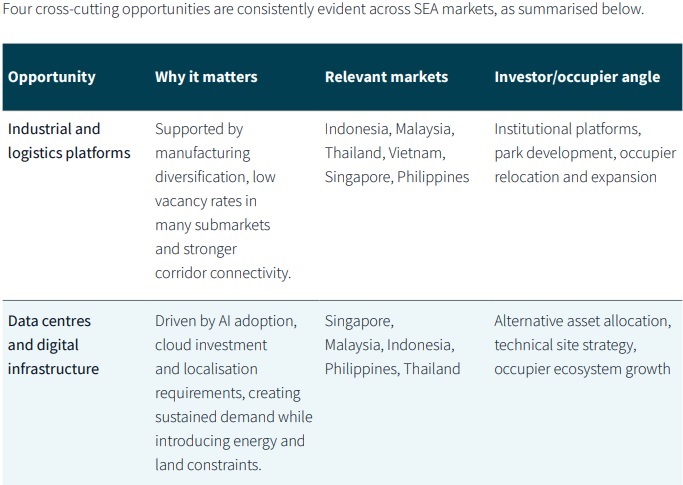
The report identified industrial and logistics platforms, data centres and digital infrastructure, asset repositioning and conversion, and cross-border and corridor plays as four of the region’s key opportunities.
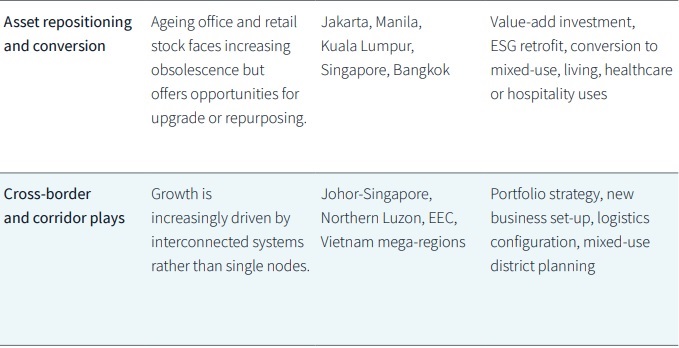
In more mature urban markets, sustainability standards are also widening the gap between future-ready buildings and ageing assets. JLL said poorly configured, energy-inefficient or functionally obsolete properties risked a growing “brown discount”, while retrofitting, conversion and repositioning created opportunities for value-add investment.
Kuala Lumpur was identified among the regional markets where ageing office and retail buildings could be upgraded or repurposed for mixed-use, residential, healthcare or hospitality uses.
Taken together, JLL’s analysis suggests investors and occupiers may increasingly need to think in terms of economic corridors rather than individual cities or countries. In Malaysia, the JS-SEZ, Penang’s manufacturing ecosystem and Greater Kuala Lumpur’s expanding transport and industrial networks illustrate how connectivity is reshaping where real estate investment and occupier demand are concentrated.
..........
EdgeProp monthly brings you data, insights and solutions for an evolving market. Subscribe now for your free copy!