Share
Share



This article appeared in the Sept 10, 2026 issue of the monthly print edition. Subscribe now.
EdgeProp’s analysis of 384 resale transactions for Kuala Lumpur condominium units found nearly six in 10 changed hands above their previous purchase prices. However, after factoring in the properties’ holding periods, the median annualised return was just 1.2%.
At first glance, Kuala Lumpur’s condominium resale market appears to have rewarded most owners who sold over the past year.
EdgeProp analysed 384 non-landed residential properties that changed hands in 12 months between July 1, 2025 and June 30, 2026. Only transactions that could be matched against their respective purchase prices were included; and in this dataset, they ran from as far back as 1980 to as recent as 2026.
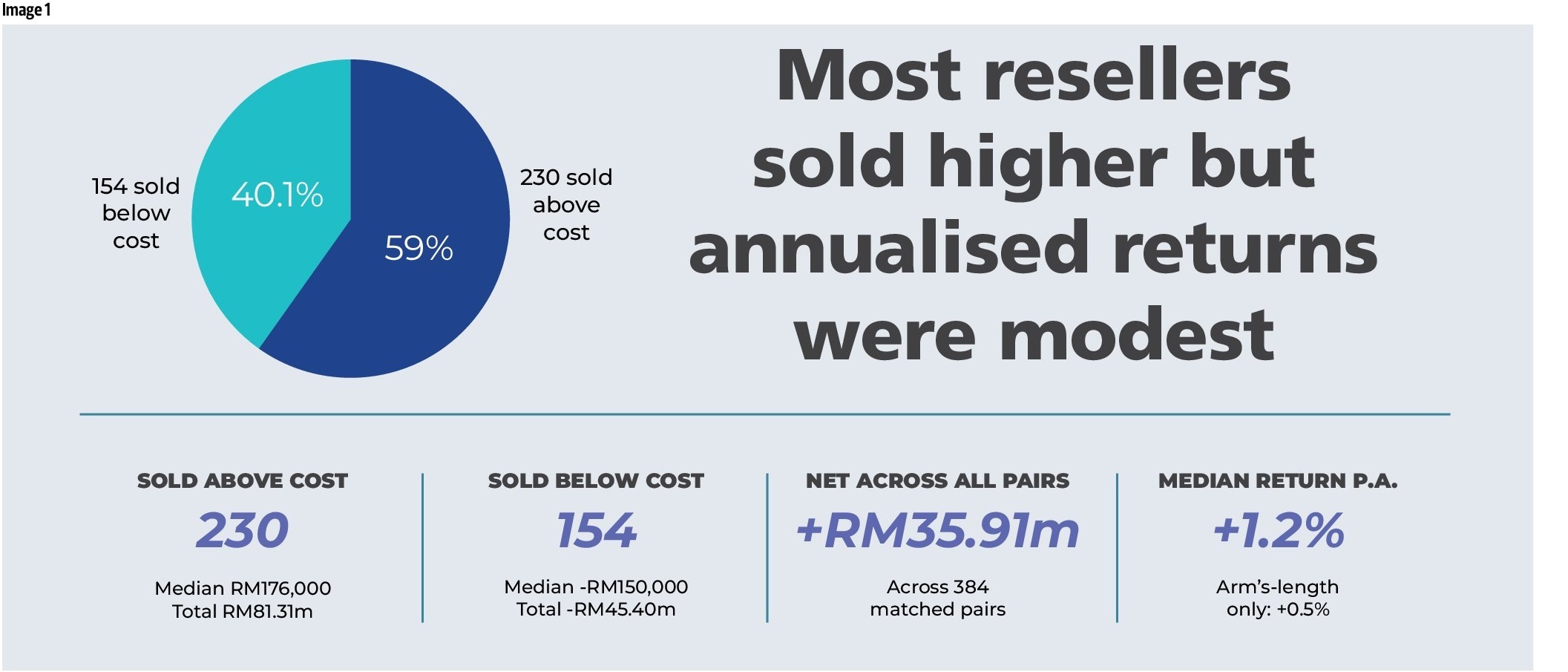
Out of the total, 230 units were shown to have been resold at higher values. That translates to 59.9% of technically profitable resales against 154 units which recorded losses (Image 1).
For the former, total gains amounted to RM81.31 million, with a median positive price difference of RM176,000. On the other hand, the latter recorded combined losses of RM45.4 million, with a median decline of RM150,000.
But there is another way to read the same transactions.
Once the length of time between purchase and resale is taken into account, the median annualised return across all 384 matched pairs was just 1.2% a year. Apply EdgeProp’s screening criteria to remove transactions displaying characteristics that could make them less representative of an ordinary open-market sale, and the median falls further to 0.5% a year.
From the transaction data analysed, six in 10 sellers made money. Yet, the typical rates at which their properties appreciated were remarkably modest.
Here is an illustration: A home bought for RM1 million and eventually sold for RM1.3 million has appreciated by RM300,000. But whether that represents a profitable investment depends on whether the RM300,000 took three years, 10 years or 20 years to accumulate.
And even that does not represent what an owner ultimately pockets, when you factor in loan interests, renovation costs, documentation fees and so on.
In short, there is a deeper layer to the KL property story rather than one told simply through rising prices. For many owners, their properties did eventually sell for more, but were the returns worth the wait?
Why win rates and returns are not the same
The prevailing story about KL condos is a simple one: buy, hold, sell, profit. Prices in the city have trended upwards for two decades, and on the surface, the resale data agrees.
Let’s review the dataset again: 384 non-landed units in KL that resold in the 12 months to June and could be tagged back to their respective preceding prices (from as recent as last year to as far back as the 1980s).
We annualised the value difference on each of the matched units by the number of years the unit was actually held, and the median came to +1.2% a year. We further omitted transactions that did not look like genuine open-market transactions such as related-party transfers, subsidised resales, or entries that were probably register errors, and the median fell to a mere +0.5% a year.
Both figures sit below what a typical mortgage costs in interest over the same period, not to mention legal fees, agent commissions or real property gains tax yet.
On a typical transaction graph, price increase will always look encouraging until returns are measured against the cost of financing. Selling high may look like a gain as it simply tells you how many ringgit has changed hands between two dates; a return tells you whether the years and outlay in between are worth it.
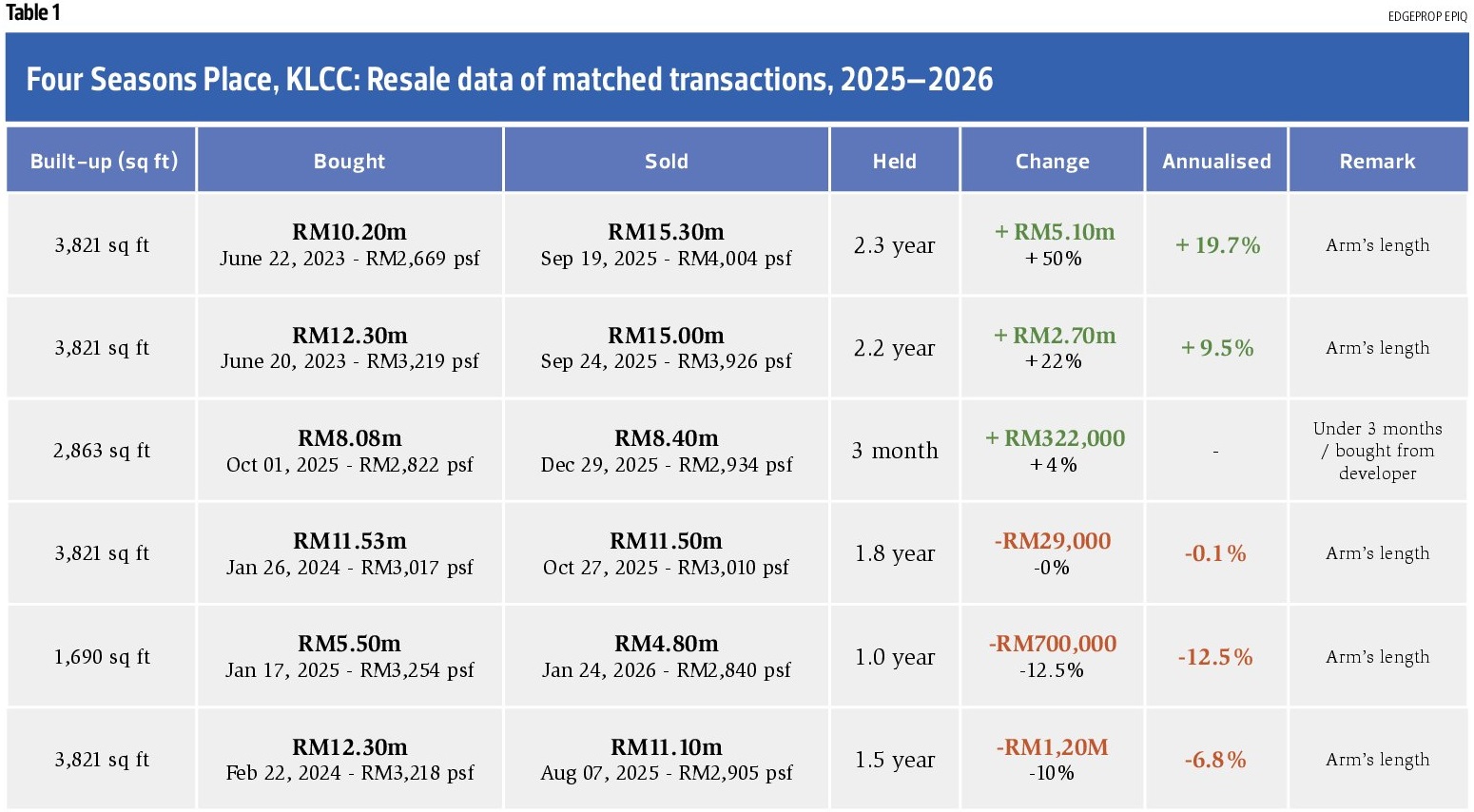
Four Seasons Place, a freehold, hotel-branded tower on Jalan Ampang, shows the gap plainly. It launched in January 2013 under developer Venus Assets Sdn Bhd and delivered 240 units, from 1,098 sq ft serviced apartments to 7,039 sq ft penthouses, rising above Four Seasons Hotel that opened its doors in November 2018.
Six matched resales there produced a combined net gain of RM6.20 million, a figure that reads, at a glance, like the market working exactly as advertised. Annualised, the same six transactions returned -0.1% a year (Table 1).
Ketumbar Heights, a less glamorous freehold condominium in Cheras completed in 2010, shows the mechanism running in reverse. Built by Mahajaya Bhd as four 14-storey blocks with compact 755–955 sq ft units, it is the kind of project that rarely makes it into a property section but it recorded 24 transactions in 2025. Out of this, we identified five matched resales, and all recorded gains, with an average annualised return of 4.1% a year.
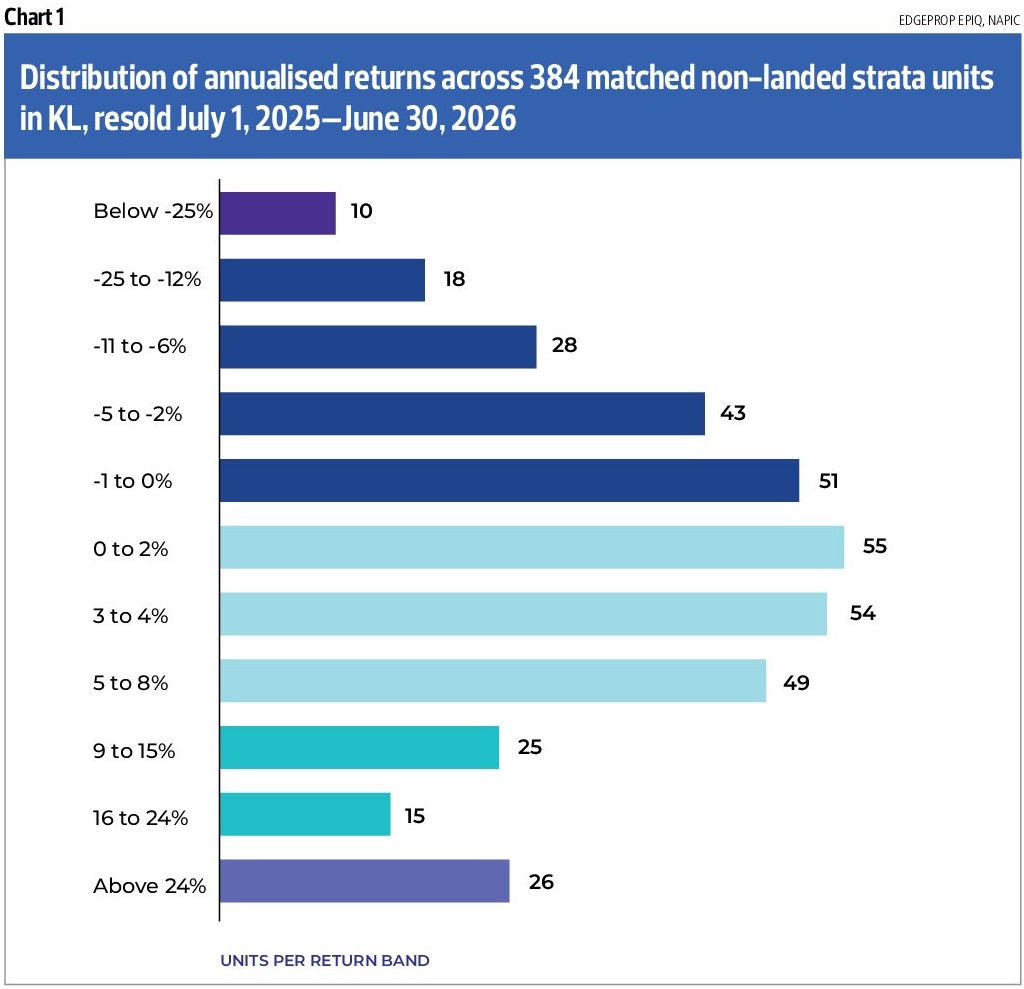
The same pattern held up across the wider market, not just in these two projects. Bucket every one of the 384 matched pairs by its annualised returns, and the band spanning -2% to +4% a year accounted for well over four in 10 of all the tracked transactions (Chart 1).
This is not a market with a handful of big winners pulling up a stagnant middle. It is a market clustered close to break even from end to end, with a long, thin tail of double-digit gains and losses stretching out on either side.
A median return close to zero is not a statistical quirk masking a genuinely strong market underneath. It is a fair description of what happened to most of the people who resold a KL condo in the past year.
Project breakdowns give clearer picture
That is the context for the project-level comparisons that follow. Net across all 384 pairs, the wins and losses together add up to +RM35.91 million — 230 winners banking a median RM176,000 apiece, 154 losers giving up a median RM150,000 apiece.
On its own, that aggregate figure reads as a healthy market. It also obscures the distinction that separates Four Seasons Place from Ketumbar Heights: a net figure this size is consistent with a market where most participants roughly broke even and a small number of large, long-held transactions did the heavy lifting, just as easily as it is consistent with broad-based appreciation.
The 384-pair total cannot tell you which of those two markets you are actually in. However, the annualised returns, and the project-by-project breakdown that follows, can.
We restricted our comparison to 14 buildings in the register that each had more than one matched resale in the period, and further narrowed it to the 10 with at least four transactions each — enough that a single unit’s outcome cannot single-handedly flip a project’s result.
Five of those 10 delivered genuinely strong annualised returns. On the other hand, another five delivered losses, or gains too thin to justify the wait. Location, tenure, developer pedigree and unit type all showed up on both sides of that split, which is itself the more interesting finding: there is no shortcut variable that explains the difference, and the market does not reward “condo in KLCC” as a single profitable category.
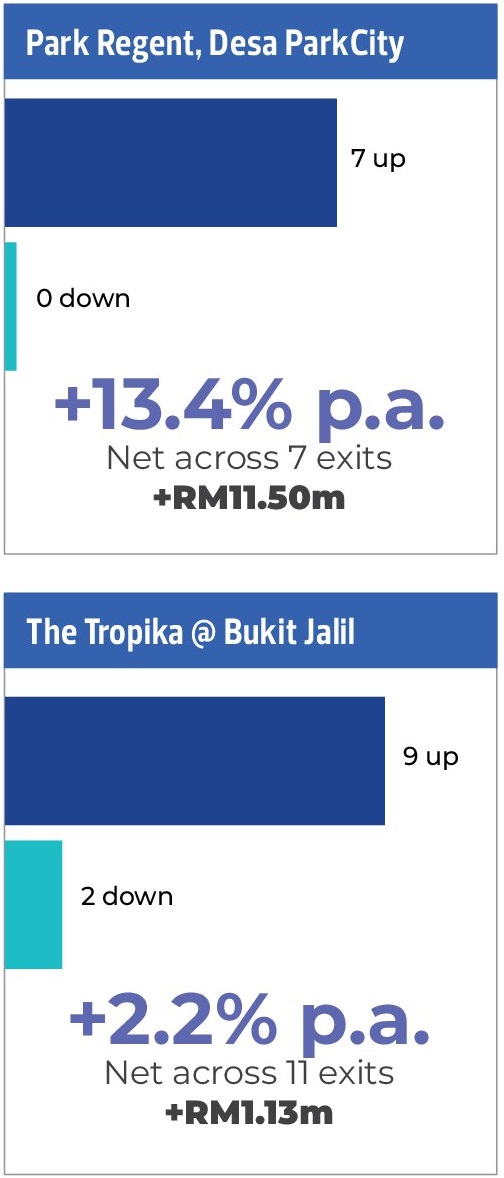
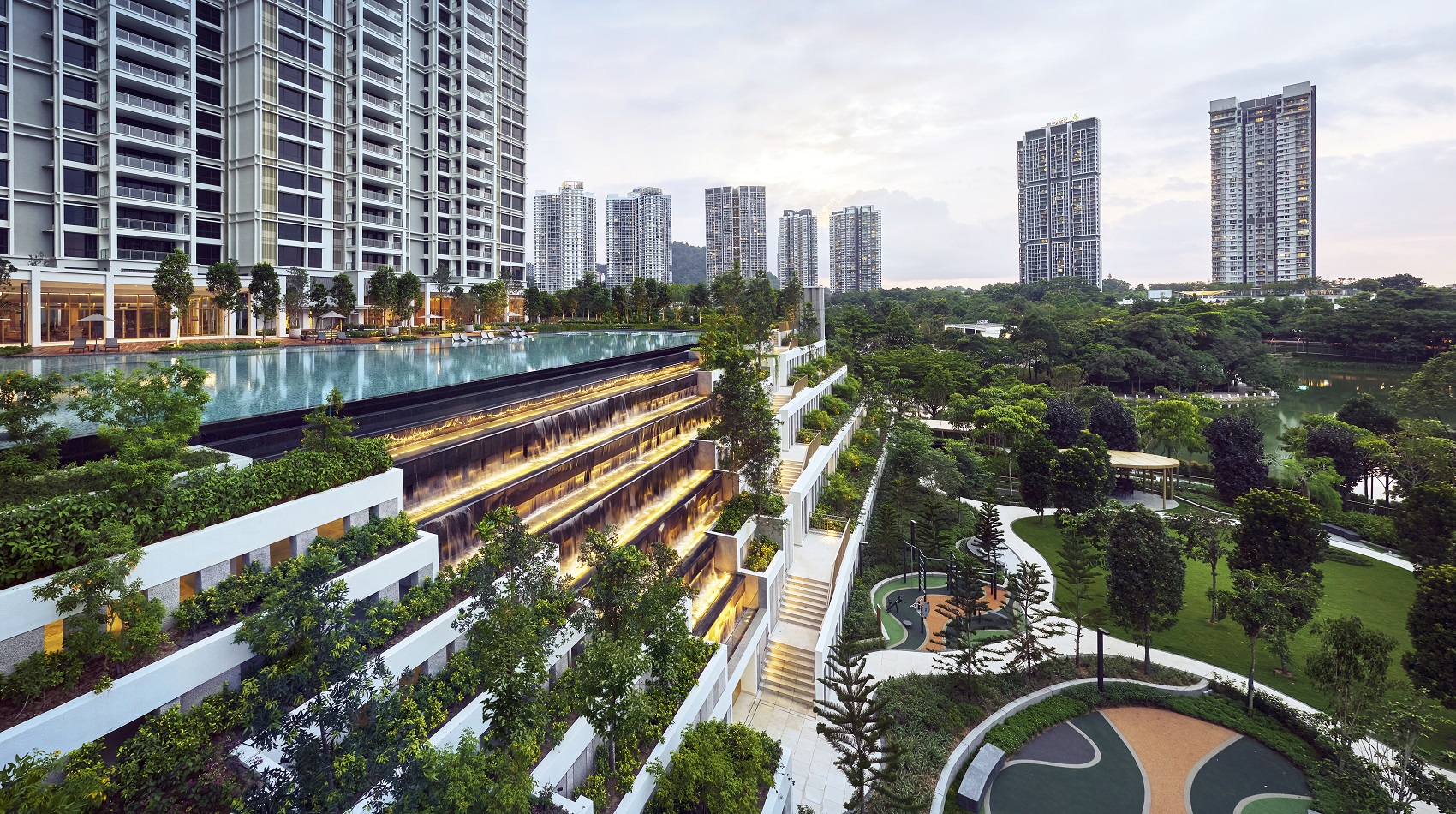
Among developments with several matched transactions, Park Regent in Desa ParkCity produced the standout result. The freehold condominium was launched in July 2019 and handed over in November 2023. Developed through a joint venture between ParkCity Group and CapitaLand Malaysia Trust, its two towers comprise 505 units, ranging 872–4,887 sq ft.
All seven units captured in EdgeProp’s matched-resale analysis changed hands above their earlier purchase prices.
Park Regent sits on a 5.6-acre lakefront site inside Desa ParkCity, and it was the first condo to break the RM1,000 psf mark in Desa ParkCity when it launched at RM1,100 psf in July 2019.
Vacant possession followed in November 2023, and every one of the seven matched resales tracked since then closed profitably — for an average annualised return of 13.4% a year. This is by far the best performer in the market.
Ketumbar Heights, described above, is the second-strongest performer in the last 12 months and the cheapest project on either list.
This proves that the top market isn’t reserved for only lakefront addresses.
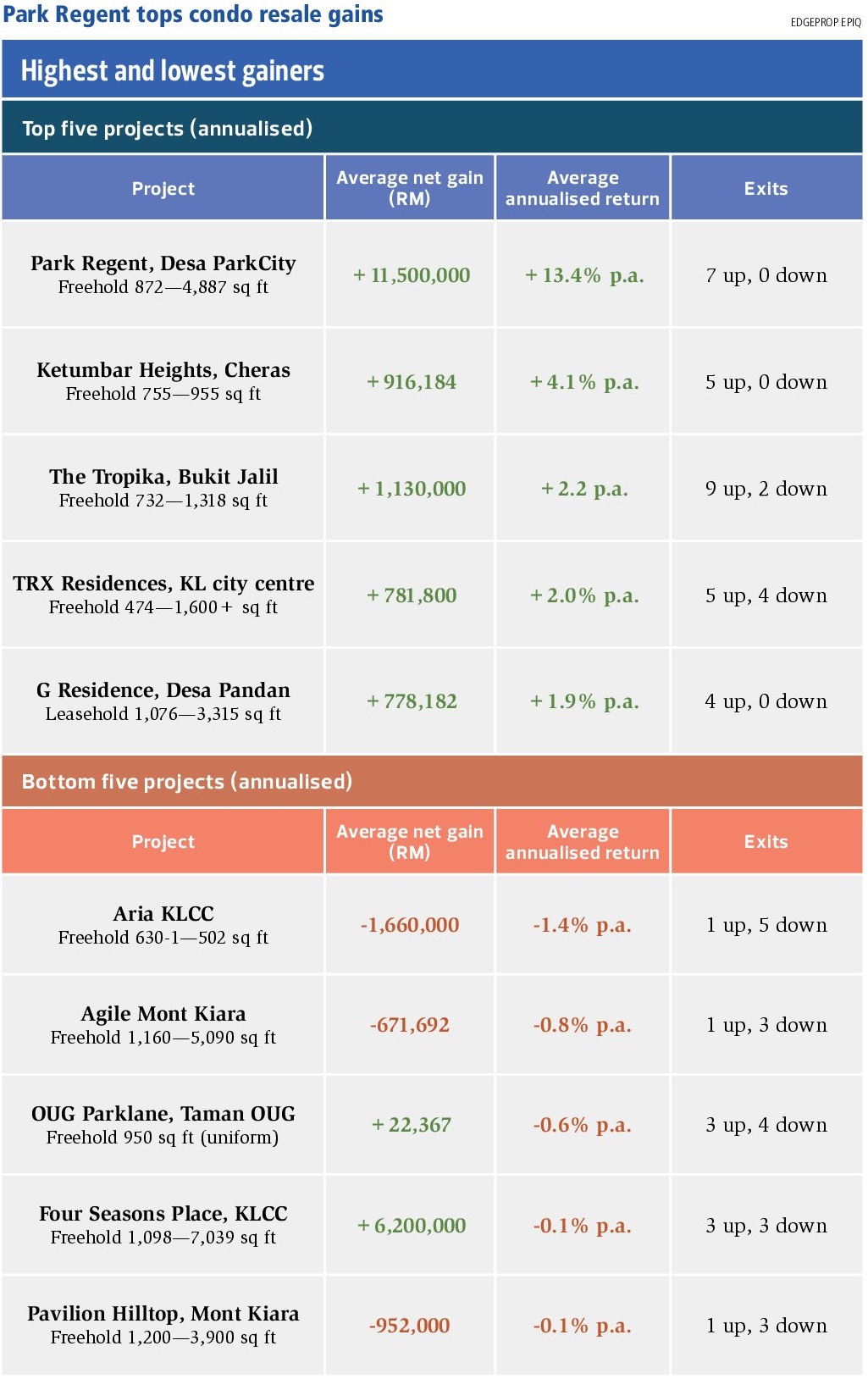
Third is The Tropika, a freehold serviced residence in Bukit Jalil developed by Berjaya Land Bhd (now known as Berjaya Property Bhd), where four towers rising 37–42 storeys look directly out over the 400-acre Bukit Jalil golf course. It launched in February 2019 and was completed on schedule in February 2023, delivering its 868 units of 732–1,318 sq ft.
Across the 11 matched resales found, nine closed in profit for an average annualised return of 2.2% a year. It is not a spectacular number next to Park Regent’s, but it is the most convincing one: a return this size, built on this many transactions, is far harder to attribute to luck than a similar figure resting on three or four sales.
The resale record at TRX Residences was even more evenly divided. Jointly developed by Lendlease Development Malaysia Sdn Bhd and TRX City Sdn Bhd, the freehold project was launched in September 2020 and handed over in 2024. Its two towers house 896 units in total, with built-ups ranging from about 474 sq ft to more than 1,600 sq ft.
As the residential component of the Tun Razak Exchange financial district, it represents a markedly different proposition from either Ketumbar Heights or The Tropika. It has so far produced a near coin-flip on outcomes with five of nine matched resales in profit and a modest 2.0% average annualised profit. The gains may be modest, but the relatively young project has held its value as the surrounding district continues to develop..
Rounding out the top gainers in the last 12 months is G Residence in Desa Pandan, the only leasehold project to make either list.
Completed in February 2015 by a joint venture between Tan & Tan Development Bhd and Sin Heap Lee Development Sdn Bhd, its two 23-storey blocks hold 474 units from roughly 1,076 to 3,315 sq ft, with west-facing units looking directly across Ampang Hilir towards the Petronas Twin Towers.
All four of its matched resales closed in profit, for an average return of 1.9% a year.
A decade of holding time and a view of the skyline appear to have counted for more here than the leasehold status that, on paper, should have worked against it.
Premium addresses not a guarantee
On the least profitable side of the ledger are projects located in KL city centre (KLCC) and Mont’Kiara, which, on paper, should have had every advantage.
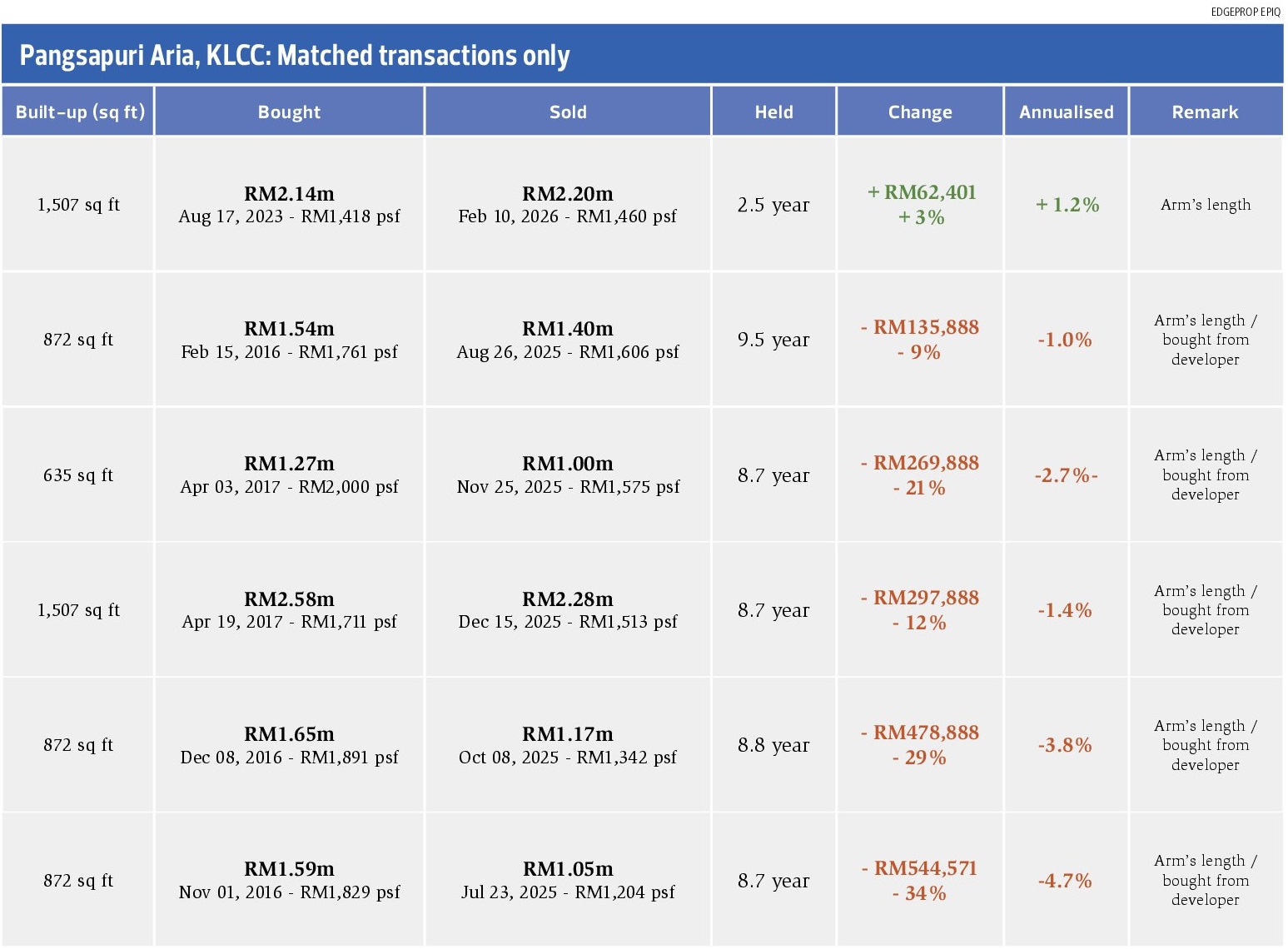
Aria KLCC sits inside KLCC’s diplomatic enclave off Jalan Tun Razak, a short walk from the Conlay MRT station and is freehold, wellbuilt, plus centrally located. Hap Seng Land Sdn Bhd completed its two 45-storey towers, comprising 598 serviced apartment units of 630–1,502 sq ft, in 2019.
Five of the six matched resales were unprofitable in the last 12 months, with an annualised return of -1.4% a year averagely.
There is nothing inherently wrong with the project and neither is it a bad development.
In fact, this is purely a case of entry price vs market cycle.
Four of the five units appear to have been bought directly from the developer in 2016– 2017. Their entry prices were roughly RM1,711– RM2,000 psf, a premium in a relatively subdued market at that time, and were subsequently sold in 2025 at only RM1,204–RM1,606 psf.
An EdgeProp report in 2017 found that the RM1 million-plus KLCC non-landed market had already peaked around 2014 and was weakening at the time of reporting. Average transacted values in that segment fell from RM1,084 psf in 3Q2014 to RM962 psf by 3Q2016, while transaction volumes also declined sharply.
What does this mean? A purchaser buying new was therefore paying the price of a newly launched luxury product. But eight years later, the next buyer is shopping in the secondary market and the seller is competing with a whole pool of completed KLCC stock.
That’s quite different from saying Aria KLCC became an undesirable development. There were about 30 transactions alone in 2025, clustering much closer to roughly RM1,400–RM1,600 psf. Rental listings on EdgeProp.my shows a 2-bedder commanding RM6,000–RM7,500 monthly.
Agile Mont Kiara tells a related story from a different entry point. It was the first Malaysian project for Agile Real Estate Development Sdn Bhd, a China-based developer, launched in January 2016 on a 10-acre site with 11 low-density blocks totalling 813 units, measuring from roughly 1,160 to 5,090 sq ft.
At launch, an estimated 70% of units were sold to international buyers from China, Hong Kong and West Asia. Completed in 2019, three of its four matched resales have since closed at losses, for a net figure of -RM671,692 and a return of -0.8% a year.
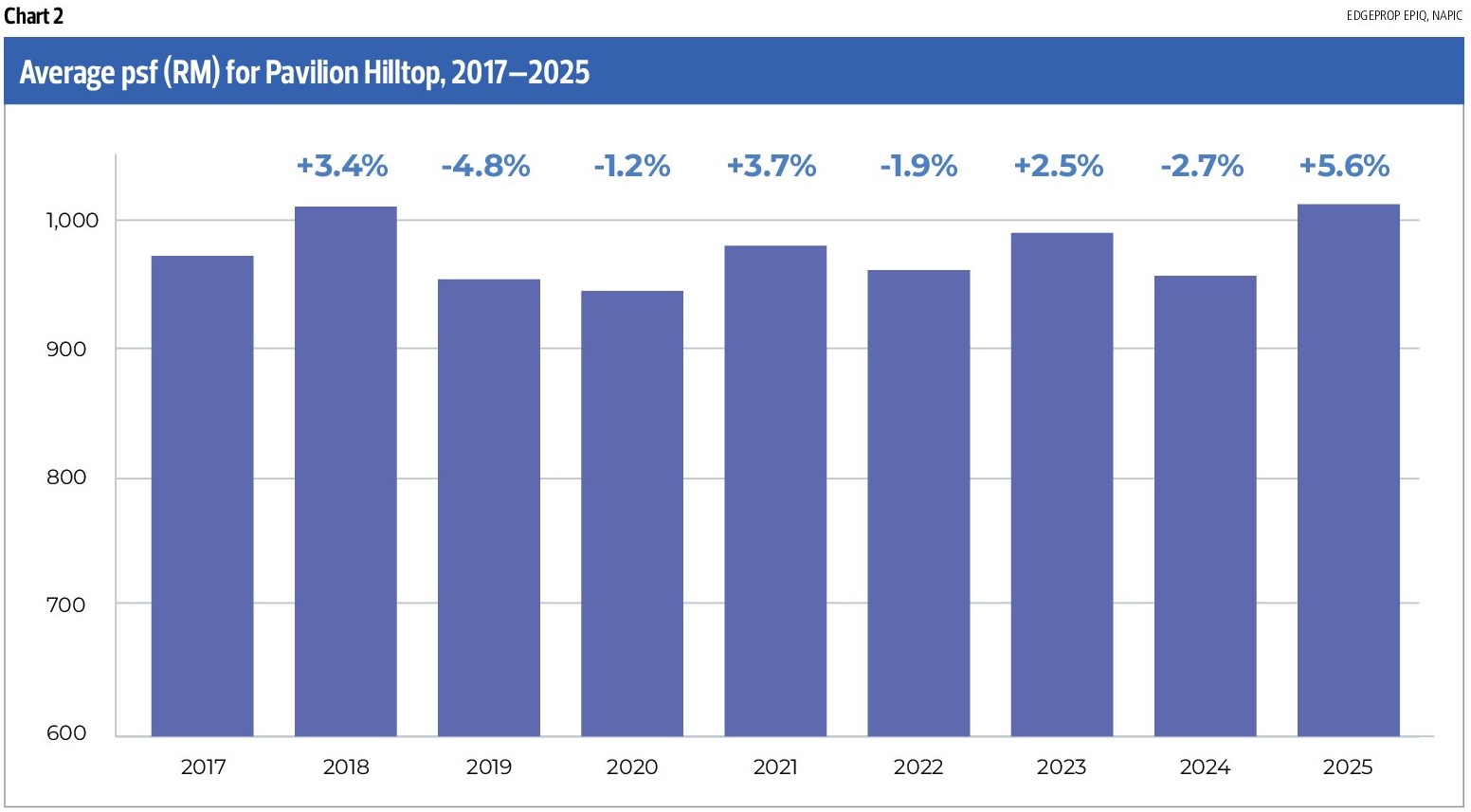
Its neighbour, Pavilion Hilltop, follows an almost identical script. A joint venture between Pavilion Group Bhd and Kuwait Finance House, its first tower launched in April 2013 was sold out within two months on marketing that pitched urban-resort-style living to Mont Kiara’s expatriate community. Three of its four matched resales in the last 12 months closed at losses for a net figure of -RM952,000 and an annualised return of -0.1% a year averagely.
Across all transactions however, when purely tracking year-on-year average psf, prices looked stable. In fact, they increased +5.6% from RM1,495.42 in 2024 to RM1,582.02 in 2025.
OUG Parklane, on Old Klang Road, makes a different point about scale. Completed by Akisama Land Sdn Bhd across three phases between 2014 and 2015, it comprises 11 towers and 4,225 units of the same uniform 950 sq ft, three-bedroom layout. Three of its seven matched resales closed in profit and four at loss.
And then, there is the project that looks like it is recording losses but, on closer inspection, is something else entirely. Agile Bukit Bintang, a freehold serviced residence on Jalan Bukit Bintang developed jointly by Agile Property Development Sdn Bhd and Tropicana Corporation Bhd, launched in June 2018 with a selling price psf of RM1,750 for over 1,500 condominium units ranging 625–1,156 sq ft.
Nine matched resales tracked here show two in profit and seven at a loss, for an annualised return of -8.2% a year averagely. We looked more closely at what was driving it. Five of the underlying units had been booked directly from the developer, some in mid-2024 at gross sale and purchase agreement prices, then re-recorded months later at prices reduced by 20% to 35% — the ordinary effect of rebates and discounts standard on Malaysian new launches being netted out on transfer, which does not imply buyers actually losing that much money.
When an apparent loss may not really be a loss
Luxury does not guarantee appreciation, and neither does being located in an established expatriate market. Leasehold, too, did not automatically consign a property to underperformance.
One factor the data does bring sharply into focus is entry price.
Property performance is ultimately measured from the price at which an owner entered the market. Two buyers can own identical units in the same building and experience very different returns simply because they bought at different points in the property cycle, or under different pricing arrangements.
The crucial determiner is the holding period.
A property sold for more after three years tells a very different story from one that took 15 years to achieve the same gain. Annualising the return puts these different holding periods on a comparable footing, and ultimately tells us not just whether a property sold higher but how hard that investment actually worked over time.
Note: For this study, we followed the same unit from one transaction to the next. Units were matched using their unit numbers and cross-checked against built-up areas or street addresses. Where a unit changed hands more than twice, only the two most recent transactions were used.
The transaction prices used in this analysis do not deduct financing costs, legal fees, agent commissions or Real Property Gains Tax (RPGT). EdgeProp's underlying analysis therefore uses 4%, representing a typical mortgage rate, as a reference point rather than a measure of actual profitability for individual owners.
WHAT THIS DATA CAN PROVE, AND WHAT IT CAN’T
This analysis is based on EdgeProp’s proprietary research using transaction data, predominantly NAPIC records to June 2026. Here are a few caveats to note:
* Every matched pair behind this analysis has been run through a series of internal checks designed to catch transactions that don’t plausibly represent a genuine open-market sale, such as same-day deals that typically indicate a transfer between related parties rather than an independent buyer and seller, subsidised housing resold at market rates, returns compounding at a pace this market has never actually sustained, and price movements large enough to suggest a register error rather than a real change in value.
* Arm’s-length transaction is loosely used here to filter transactions between two unrelated, unaffiliated parties, where the property has had reasonable exposure to the open market and neither side is under compulsion to sell.
* Nothing in this piece should be read as a professional valuation of any property or project named. What this analysis offers instead is a pattern read off a large number of real, dated transactions, with the most obvious signs of a non-market price screened out. For EdgeProp, this can be taken as a useful signal for buyers and sellers, but does not replace professional valuation.
* Gross change is not profit or loss. Legal fees, financing costs, agent commissions and RPGT sit between the gross transaction prices analysed here and whatever sellers eventually retained. None is deducted from the gains reported in this analysis.
..........
EdgeProp monthly brings you data, insights and solutions for an evolving market. Subscribe now for your free copy!
.jpeg?Dc.IvzT0vI55UUTaKxAW9caca44P99nz)