Share
Share


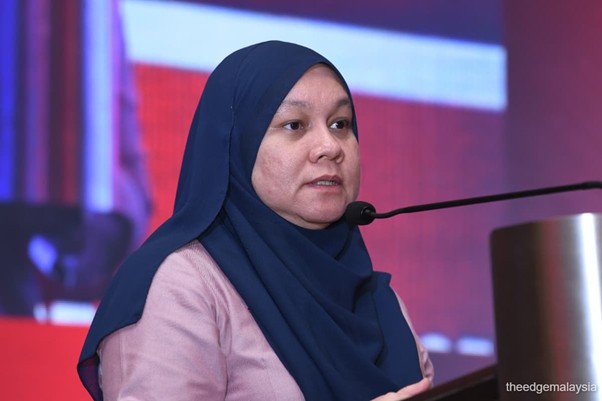
- She said flexible engagement with industry players would be important, as energy “cannot be regulated in a static way” given the pace of transition and market development.
KUALA LUMPUR (Dec 9): The Energy Commission (EC) will start developing rules for cross-border electricity trading in early 2026, after recent amendments to the Electricity Supply Act 1990 expanded its authority over power imports and exports, said CEO Siti Safinah Salleh.
She said the new regulations will set out how cross-border electricity trading works, including technical and economic requirements. This will be one of the EC’s first tasks after the amended Electricity Supply Act — which gives it authority over energy trade beyond Malaysia — comes into force.
Siti Safinah was speaking to reporters on the sidelines of the Energy Regulatory Insights 2025 forum.
The Dewan Rakyat on July 30 passed the Electricity Supply (Amendment) Bill, which expands the scope of the Electricity Supply Act 1990 to include the regulation of electricity import and export, as well as the management of green energy attributes.
One of the key provisions in the bill empowers the EC to oversee cross-border electricity trade. Following the approval of this bill, the House also passed the Energy Commission (Amendment) Bill.
Siti Safinah further said the regulatory framework will also support the development of the Asean Power Grid (APG) initiative, which facilitates multilateral electricity trading and allows member countries to obtain support in the event of supply disruptions.
She cited Malaysia’s existing cross-border exchange arrangement with Thailand, used both for bilateral transfer and as part of the Lao PDR–Thailand–Malaysia–Singapore (LTMS) Power Integration Project, which enables energy generated in Laos to be transmitted through Thailand and Peninsular Malaysia into Singapore.
The agreement between the four countries is currently in its final stages of conclusion, she added.
Malaysia has already experienced the benefits of these mechanisms, she said, noting that both Thailand and Singapore provided grid support during a recent unplanned outage at a major power plant in Melaka.
With the launch of the EC Strategic Plan 2026–2030, Siti Safinah said the commission is repositioning itself as a forward-looking regulator to prepare the energy sector for structural changes over the next decade, including new technologies, more competitive markets and the expansion of competent-person capabilities.
She said flexible engagement with industry players would be important, as energy “cannot be regulated in a static way” given the pace of transition and market development.
“We need to move with agility but also be a lot more flexible in how we regulate the energy sector moving forward. That is something that we aim to interact with the industry players as well,” she said.
Unlock Malaysia’s shifting industrial map. Track where new housing is emerging as talents converge around I4.0 industrial parks across Peninsular Malaysia. Download the Industrial Special Report now.