Share
Share


This article first appeared in the Industrial Special Report in November 2025.
Malaysia’s electric-vehicle (EV) journey extends far beyond cleaner air and lower carbon emissions—it is reshaping the very foundation of the nation’s industrial real estate. What began as a push for greener mobility has evolved into a strategic transformation of Malaysia’s manufacturing ecosystem, setting new benchmarks for power, precision, and progress.
This evolution reflects Malaysia’s fierce commitment to attracting both foreign (FDIs) and domestic direct investments to drive high-technology ventures that move the national economy up the value chain. The policy framework is clear. The Malaysian Investment Development Authority (Mida), in an online article dated Feb 20, states the New Industrial Master Plan (NIMP) 2030 identifies EVs and renewable energy as priority sectors, and supports 3,000 smart-factory conversions by 2030. On top of that, the National Energy Transition Roadmap (NETR) targets EVs and hybrids to form up to 80% of the industry volume by 2050. At the same time, under the Low Carbon Mobility Blueprint 2021–2030, Malaysia is committed to rolling out 10,000 public EV charging stations by 2025, states the Malaysian Green Technology and Climate Change Corporation’s website, and this will reinforce the infrastructure base for electrified mobility in Malaysia..
In this landscape, the rise of EVs is not merely about vehicles, it’s about redefining industrial property as the platform of the new economy, powering Malaysia into a smarter era.
When the government’s electrification thrust meets its hi-tech ambitions
With Malaysia firmly positioning itself as the next major EV and advanced manufacturing hub for Asean, domestic demand has certainly accelerated.
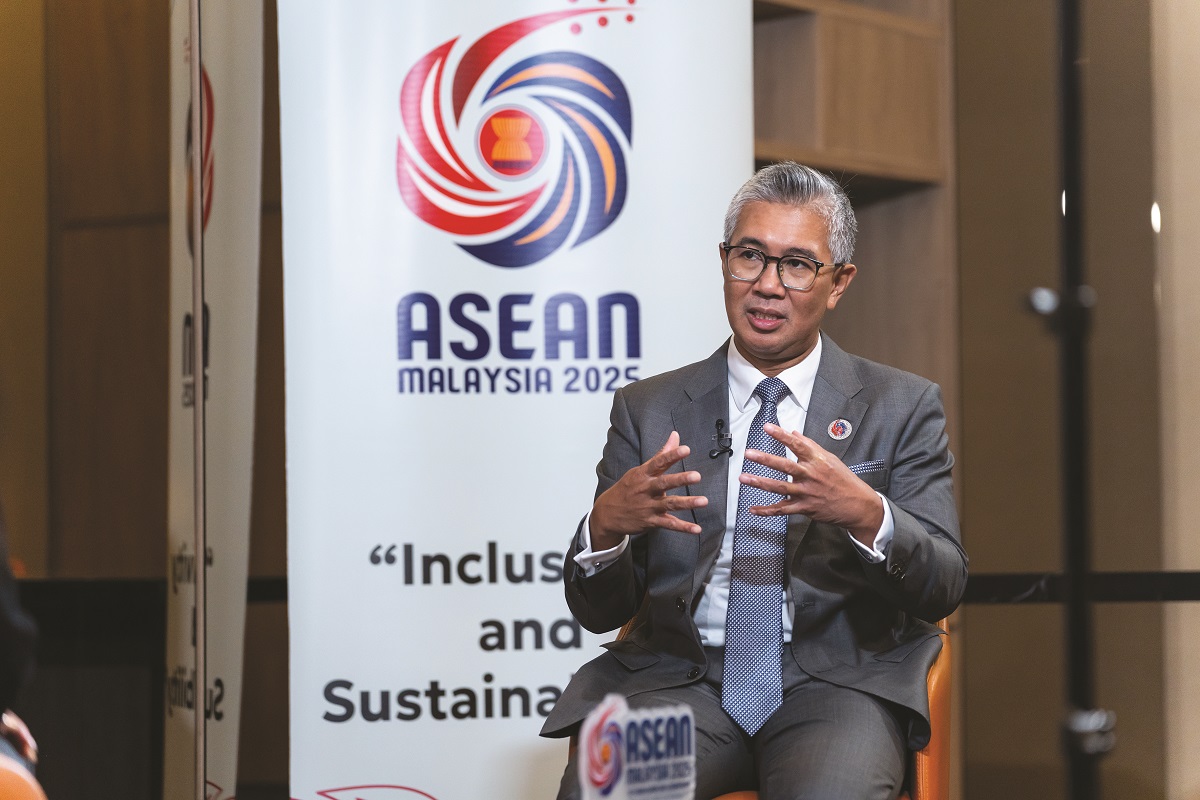
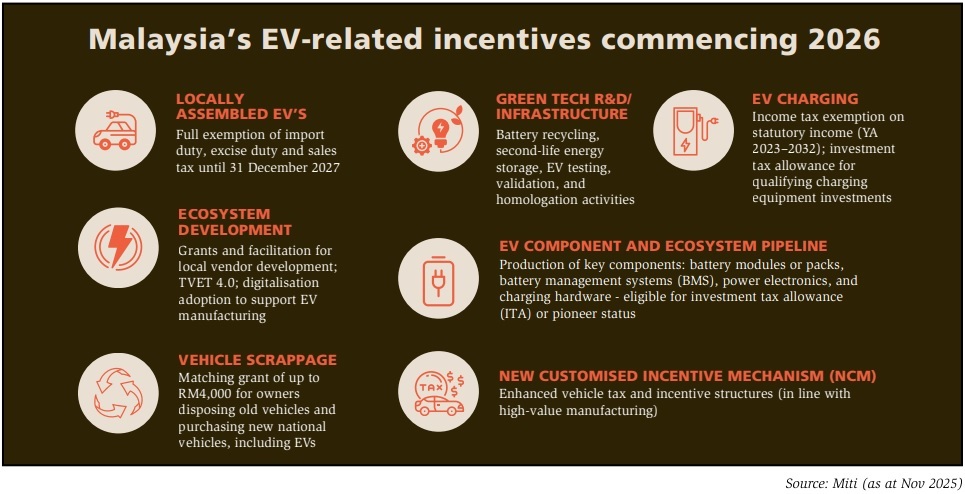
Benefitting from the government’s vast incentives to spur ownership, EV sales rose 91.4% in 1H2025, Investment, Trade and Industry (Miti) Minister Tengku Datuk Seri Zafrul Abdul Aziz tells EdgeProp in an exclusive interview.

A deliberate national strategy blending electrification, high-technology development, and industrial upgrading has been hatched to reinforce that Malaysia is not here to follow the EV transition, but to shape it for the region, stresses Zafrul.
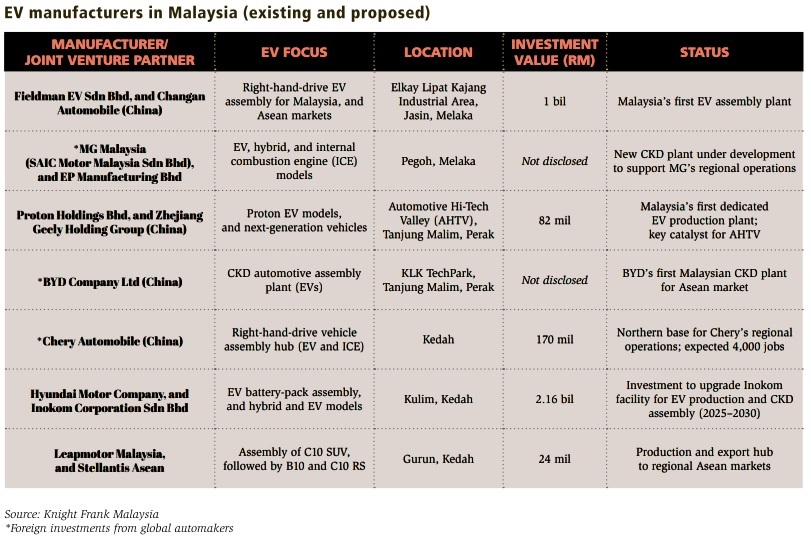
National brands are central to this ambition—Perodua is developing affordable compact EVs, while Proton advances its e.MAS series through global partnerships. At the same time, international original equipment manufacturers (OEMs) such as Volvo, MercedesBenz, and Chery have already started to assemble EVs locally, while Chinese EV giants deepen interest in establishing production bases.
However, with completely built-up (CBU)-car incentives ending in 2025, and local manufacturing incentives for completely-knocked-down (CKD) models running until 2027, Malaysia is entering a new phase where domestic EV production accelerates, and tier-1 component players, especially in battery systems, scale rapidly. The approach is clear: build an end-to-end ecosystem, not just assemble cars.
Zafrul reinforces this trajectory: “The more we localise high-value components, the stronger Malaysia’s position becomes in the global EV supply chain”.
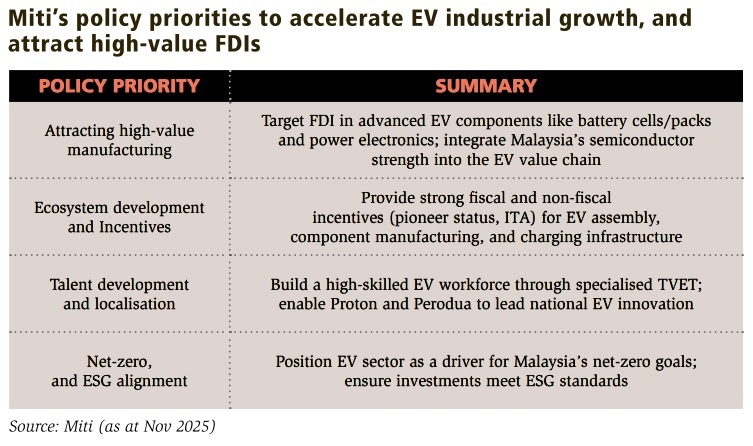
Miti’s priorities are to attract advanced battery and power electronics investments, integrate Malaysia’s semiconductor clusters into EV value chains, expand talent pipelines, and advance environmental, social and governance (ESG) credibility through the Battery Passport initiative.
With these drivers in motion, Malaysia is aligning its electrification agenda with its high-tech vision—creating high-income jobs, boosting export competitiveness, and cementing its place as Asean’s next EV powerhouse.
Integrated industrial ecosystems positions Malaysia as regional EV powerhouse
Malaysia’s industrial property ecosystem is emerging as a decisive advantage in the global China + 1 shift, especially for EV players seeking stability, speed and strategic neutrality.
“Malaysia is not just participating in the China + 1 strategy, we are becoming a preferred destination for it,” says Zafrul.
With ready-built factories, mature semiconductor clusters, strategic landbanks, and strong port–airport connectivity, Malaysia offers fast setup, lower capital expenditure, and deep supply-chain integration. Combined with EV-focused incentives and a geopolitically neutral, free-trade-agreement (FTA) position, the country is becoming one of Southeast Asia’s most compelling hubs for global EV expansion.

The EV investment wave spans Malaysia’s north–south industrial corridor, from Kulim, Kedah; Tanjung Malim, Perak; to Jasin and Pegoh in Melaka; and Senai in Johor Bahru. Collectively, these industrial parks attract billions of ringgit in FDI and position Malaysia as a regional hub for EV manufacturing and supply chain integration.
“Beyond basic industrial infrastructure, an EV-ready park needs scalable land parcels, a stable high-capacity power supply, and seamless access to highways, ports, and airports,” explains Knight Frank Malaysia land and industrial solutions executive director Allan Sim. He adds that sustainability, and technology integration are now essential as well, combined with strong digital connectivity, and a skilled workforce.
“These features make Malaysia’s industrial parks uniquely positioned to support the nation’s fast-growing EV manufacturing ecosystem,” he tells EdgeProp in an exclusive interview.
Sim cites the following industrial parks as emerging hubs for EV-manufacturing activities:
1. Automotive High-Tech Valley (AHTV), Tanjung Malim, Perak
Positioned as Malaysia’s flagship Next-Generation Vehicle (NxGV) and EV cluster, AHTV is a dedicated ecosystem combining assembly, R&D, and advanced vehicle connectivity technologies. Anchored by Proton and China’s Zhejiang Geely Holding Group Co’s RM40 billion investment, the park is set to attract global vendors and develop a talent and innovation hub for EVs.
Incentives include:
*Up to 100% Investment Tax Allowance and full income tax exemption for up to 15 years
*Exemptions on import, excise, and stamp duties
*Sales tax exemption on raw materials, machinery, components, spare parts, and consumables used in manufacturing within AHTV
2. Inokom Automotive Complex, Kulim, Kedah
Long a cornerstone of Malaysia’s automotive landscape, Inokom is evolving into a modern EV production hub.
Owned primarily by Sime Darby Motors Sdn Bhd, with shareholding including Bermaz Auto Bhd, and South Korea’s Hyundai Motor Company, the RM2.16 billion investment is the facility for EV battery-pack assembly and the production of six new hybrid and electric models. Its innovative “plant-within-a-plant” concept enables multiple automakers to operate side by side, leveraging shared infrastructure while maintaining independence, creating an efficient, collaborative environment ideal for high-tech EV assembly.
3. Hicom Pegoh Industrial Park, Melaka
Melaka is fast emerging as a supportive EV supply-chain base, attracting investments in battery pack assembly, thermal management solution, inverters, and vehicle control software. While Melaka’s ability to attract component manufacturers is at its infancy, its industrial parks are gaining reputation as well-zoned parks with development-ready infrastructure and strong institutional backing. MG Malaysia (managed by SAIC Motor Malaysia Sdn Bhd, a subsidiary of the Chinese automotive giant SAIC Motor), and EP Manufacturing Bhd are establishing a CKD car assembly plant here, strengthening Malaysia’s EV component ecosystem. Complementing this industrial push, local universities such as Universiti Teknikal Malaysia Melaka (UTeM) and Melaka Polytechnic are developing EV-specific technical training, ensuring a pipeline of skilled engineers for the growing indus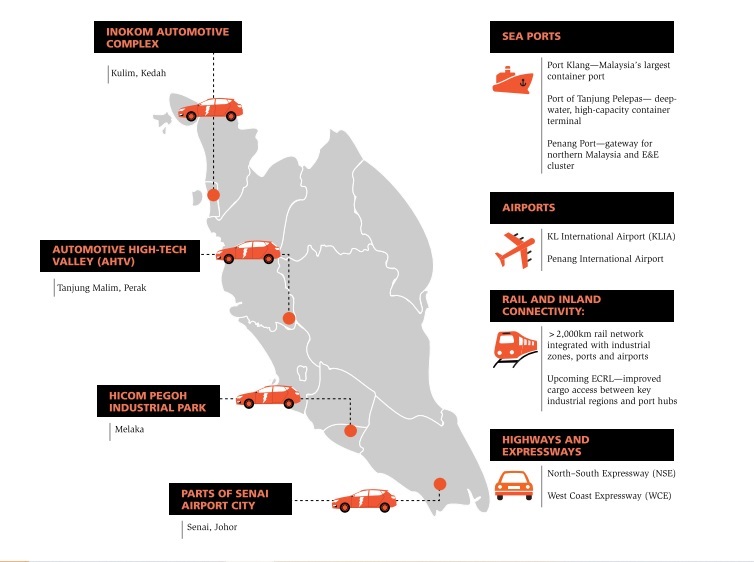
Potential nerve centre of Asean’s EV ecosystem
With Asean on course to becoming the world’s fourth largest economy by 2030, the potential for EVs is huge. Riding on the wave, Malaysia is accelerating its bid to become Asean’s next EV manufacturing hub, offering Chinese OEMs a compelling base supported by strong incentives, mature industrial infrastructure, and strategic logistics links to regional markets.
By driving localisation, building domestic vendor capabilities, and encouraging technology transfer, Malaysia is strengthening its EV value chain while creating long-term industrial depth. Zafrul reveals that the targeted investment missions and streamlined facilitation by the Malaysian Investment Development Authority (Mida), and Malaysia Automotive Robotics & loT Institute (MARii) is positioning Malaysia as a highly competitive platform for Chinese automakers and tier-1 suppliers to serve both the domestic market, and the wider Asean right-hand-drive export region.
On top of that, what sets Malaysia apart is its integration-ready ecosystem, says Sim. The country boasts an established electronics and semiconductor base, anchored by global leaders such as Intel, Infineon, Texas Instruments, and STMicroelectronics, supporting advanced EV components like sensors, chips, and power modules.
“We also have a strong automotive supply chain, backed by brands including Proton, Perodua, Toyota, and Honda, which promise local capability in precision engineering and assembly,” he highlights.
Coupled with advanced manufacturing infrastructure across Penang, Selangor, and Johor, and a skilled technical workforce trained in mechatronics, robotics, and embedded systems, Malaysia offers the ideal foundation for high-value EV production.
High level of industrial readiness
Zafrul points out that Malaysia’s industrial ecosystem is anchored by reliable infrastructure, and advanced utilities designed for energy-intensive operations.
The nation maintains a 35% power reserve margin, with Tenaga Nasional Bhd investing RM43 billion in grid modernisation to ensure continuous, high-capacity energy delivery. Industrial corridors—from Penang, Klang Valley to Johor—enjoy robust water infrastructure through Pengurusan Aset Air Bhd (PAAB) and state providers, complemented by flood-mitigation systems, and industrial wastewater treatment networks.
Sim adds that digital readiness is equally strong. Malaysia ranks first in the SEA-5 Data Centre Opportunity Index, with 5G coverage surpassing 80% of populated areas as of 2024, enabling IR 4.0 applications such as smart manufacturing, automation, and robotics.
Additionally, Malaysia’s multimodal transport network gives it a decisive edge in EV manufacturing. Industrial hubs in Johor, Penang, Melaka, and the Klang Valley are seamlessly linked to major ports, airports, and highways, ensuring smooth movement of vehicles and components.
This integrated logistics ecosystem delivers cost efficiency, export readiness, and supply-chain agility, key advantages for EV manufacturers and suppliers looking to scale across Asean and beyond.
EV momentum supercharging industrial real estate
Malaysia’s wave of EV-led investments is reshaping the industrial property landscape. As automakers and component producers expand, demand for high-power, scalable industrial sites is accelerating, particularly across key corridors in Johor, Perak, Kedah, and Melaka. The growing network of battery, electric motor, and component manufacturers is spurring a clustering effect, with tier-1 and tier-2 suppliers gravitating near anchor plants such as Proton–Geely, BYD, and Chery, says Sim.
This concentration of activity is driving strong land absorption, tightening supply, and pushing up rental momentum in well-established industrial parks.
As supply chains deepen, both new and secondary zones are seeing increased uptake, reinforcing Malaysia’s position as the region’s next industrial growth engine for EV manufacturing.
Challenges and strategic levers
Malaysia’s push to become a regional EV manufacturing hub is gaining traction, but key challenges remain: high battery costs, fragmented supply chains, limited skilled talent, and inconsistent charging infrastructure. Additionally, the domestic market is highly competitive and relatively small, making it harder for newcomers to achieve economies of scale quickly. For new investors, they must integrate into a localisation ecosystem that has yet to fully mature.
“At the government level,” Sim suggests, “we need sharper incentives. Cut tariffs, and extend targeted support not just to OEMs, but across the entire EV value chain. A fragmented ecosystem won’t attract serious investment”.
Sim also recommends performance-based incentives for firms investing in local R&D, automation, and green manufacturing; fast-tracked approvals for EV projects; and aggressive investment in workforce upskilling and EV-specific R&D to close the talent gap.
Establishing EV Centres of Excellence with OEMs and universities could also drive innovation and local certification capabilities.
Zafrul acknowledges the shortfalls, and points out how Malaysia is strengthening its EV ecosystem by addressing key structural gaps, and sharpening policy clarity.
“The review of the National Automotive Policy (NAP) 2020 is a pivotal step, aligning national frameworks with global EV trends and creating a more stable, liberalised environment for investors.
This reset cuts uncertainty and enables automakers to operate with better efficiency,” he elaborates.
Sustained growth for industrial real estate
Investor sentiment in Malaysia’s industrial-real-estate market is strengthening as global manufacturers increasingly prefer to own and self-develop their facilities. According to Sim, this trend “signals long-term investor confidence and points to sustained value growth for strategically located industrial assets”.
However, Sim is clear: “Design EVready parks with high-power capacity, modular plots, and ready utilities. Don’t just build for the big players, support the entire supply chain”.
He urges developers to co-design park layouts with EV players, integrating charging, testing, and logistics zones while incorporating plug-and-play infrastructure, and shared service facilities like testing labs and recycling zones. A focus on long-term value creation through purpose-built environments that accelerate production readiness is essential.
Coupled with the government’s continued fiscal incentives for CKDs until 2027, and the rollout of EV-charging infrastructure, and EV-ready industrial parks, Malaysia is positioning itself as a key investment hub for the regional EV boom.
“These are not just enablers, they’re strategic levers to position Malaysia as Southeast Asia’s EV powerhouse,” Sim concludes.
..........
Unlock Malaysia’s shifting industrial map. Track where new housing is emerging as talents converge around I4.0 industrial parks across Peninsular Malaysia. Download the Industrial Special Report now.