Share
Share


This article appeared in the Sept 10, 2026 issue of the monthly print edition. Subscribe now.
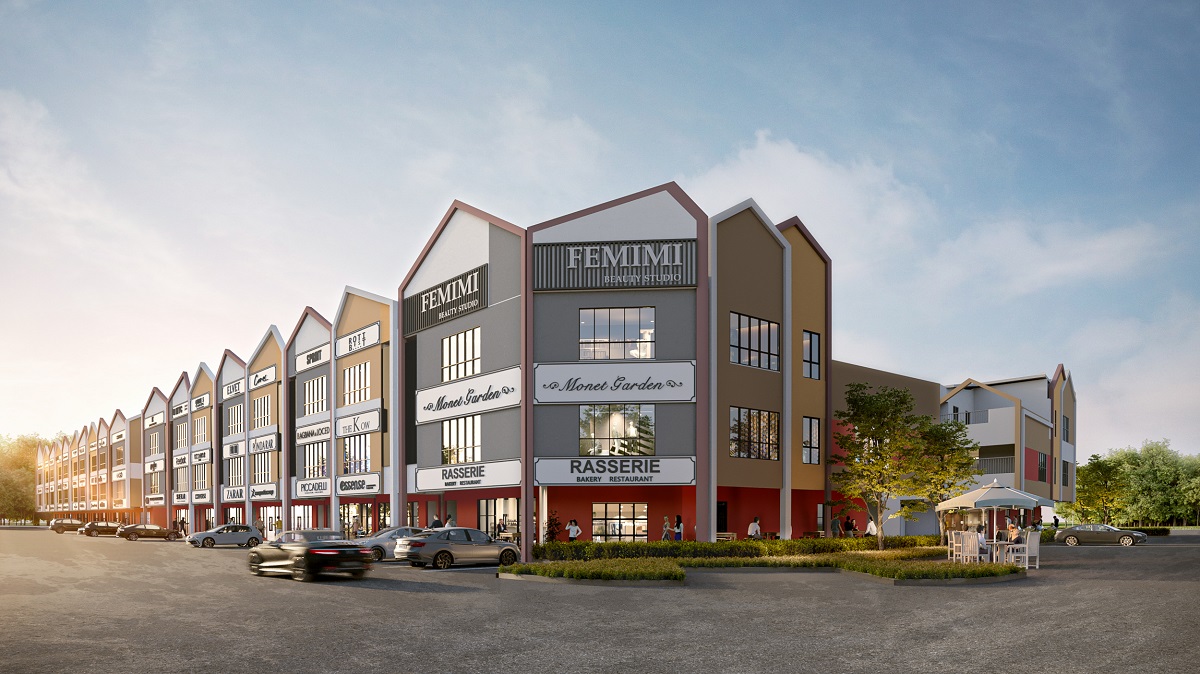
The debate over urban renewal has often been propped up by attractive artist impressions of modern highrise developments and promises of better living conditions. Yet, behind every redevelopment proposal lies one critical question that policymakers cannot afford to ignore: Who owns the land?
This can be the dividing line between a redevelopment project that proceeds relatively smoothly and one that becomes embroiled in years, if not decades, of negotiations and legal disputes.
Unfortunately, discussions on urban renewal have tended to lump all ageing developments into a single category. In reality, there is a world of difference between single ownership and multiple ownership, and any legislation that ignores this distinction is likely to encounter enormous practical difficulties.
Single ownership — the easier path
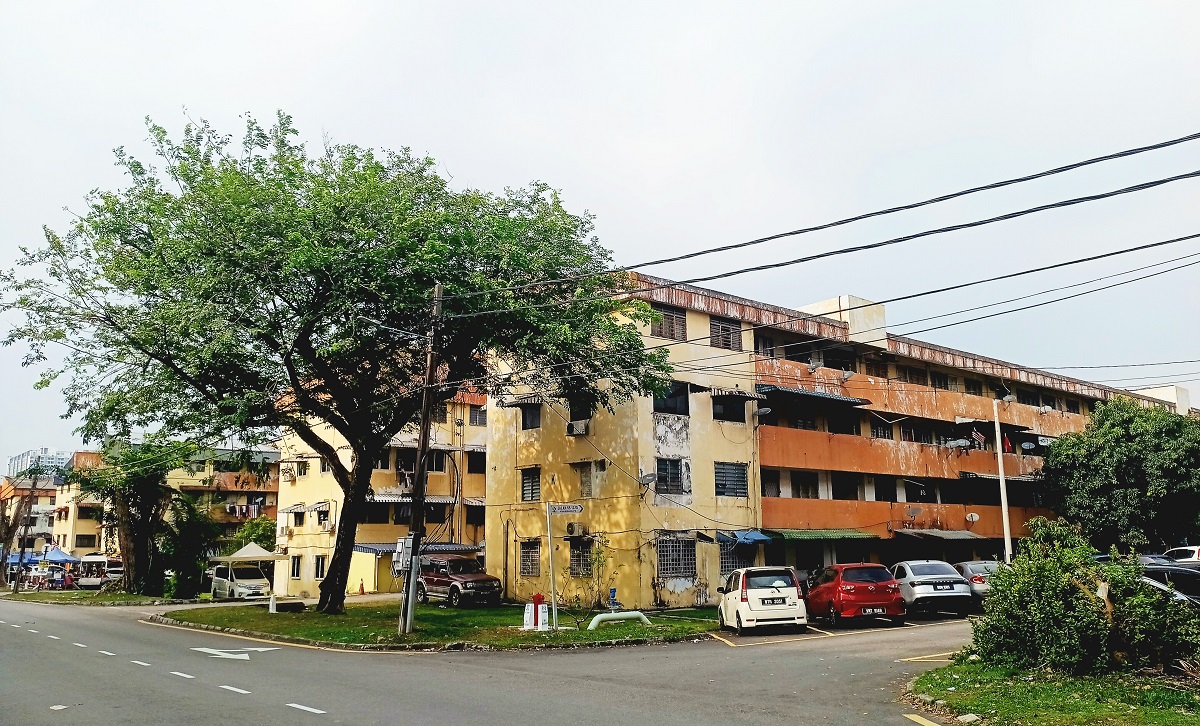
Single ownership refers to properties where one entity owns the entire development. Examples may include public housing or other housing estates whose land and buildings remain under the ownership of a government agency, statutory body or other single entity.
In such cases, the ownership-related legal and administrative process is generally more straightforward because there is only one registered owner to deal with. Subject to applicable law and any contractual, occupancy or other third-party rights, the owner may decide whether to demolish, rebuild, redevelop or upgrade the property without having to obtain the agreement of numerous proprietors with differing interests and expectations.
Where the government or a public agency owns the entire development, relocation, redevelopment and financing may also be planned as part of a broader housing programme.
Multiple ownership — an entirely different challenge
The situation changes dramatically once a development is sold to individual purchasers.
A stratified residential development may consist of hundreds or even thousands of parcel owners. Each owner has legal rights and interests in his or her parcel, together with statutory rights associated with the development’s common property.
The ownership circumstances can also vary considerably because:
1) Many units are subject to bank charges
2) Some belong to investors
3) Others are inherited by several beneficiaries
4) Some are under probate, bankruptcy proceedings, divorce settlements or court disputes
5) Foreign owners may be living overseas 6) Companies may own commercial units
7) Government agencies may own certain parcels
Each situation may involve different legal, financial and practical considerations.
Obtaining agreement from such a diverse group is not simply an administrative exercise — it is a complex process involving multiple property interests, financing arrangements and legal rights.
One law cannot fit both categories
Unlike a single owner making one commercial decision, multiple ownership requires balancing the interests of numerous proprietors.
For many owners, the property is not merely an investment. It is their only home. Some elderly residents have lived there for up to even 50 years. Many have built communities, businesses and family support systems around their neighbourhoods.
Urban renewal therefore affects far more than bricks and mortar. It affects livelihoods, schools, places of worship, businesses and social networks. These cannot simply be measured in monetary compensation.
This is where policymakers must exercise caution.
A redevelopment framework designed for a single-owner public housing development cannot automatically be applied in the same way to privately-owned stratified developments.
Government-owned housing may involve one registered owner making the principal redevelopment decision, although other legal and occupancy interests may still need to be addressed.
Private strata developments, by contrast, involve numerous individual proprietors. These interests engage the constitutional protection that no person may be deprived of property save in accordance with law; and where property is compulsorily acquired or used, adequate compensation is also required.
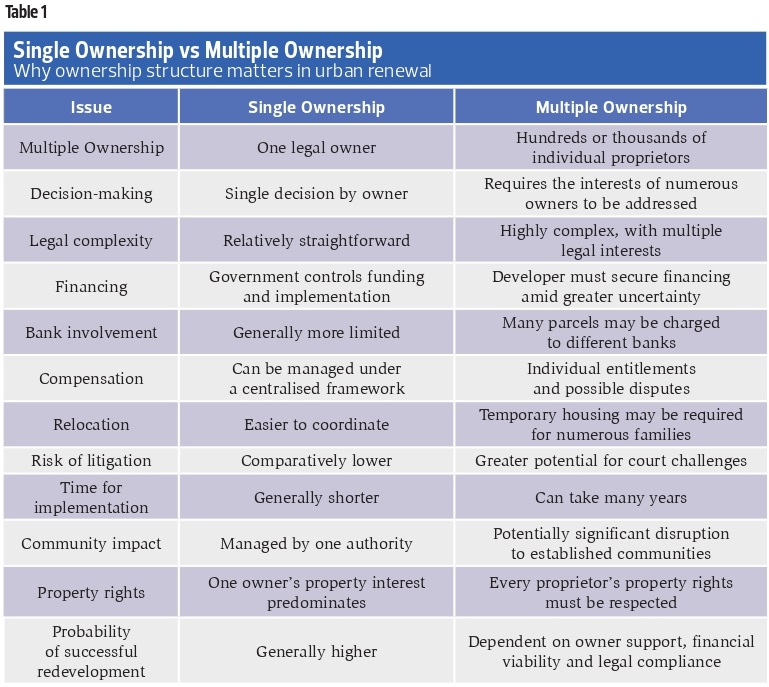
The practical realities involving legal, financial and social circumstances are therefore fundamentally different (Table 1). To treat both categories identically would be to ignore these differences in ownership structure.
Financial and social reality
Redeveloping a single-owner property can provide greater certainty when planning and budgeting for relocation and reconstruction.
In contrast, redevelopment of multiple-owner properties presents different financial challenges. Depending on the transaction structure, developers may have to negotiate acquisition or compensation costs, address outstanding financing secured over individual parcels, provide temporary accommodation where necessary, absorb construction risks and satisfy financiers’ requirements.
Disputes may result in litigation or other proceedings, potentially delaying projects and increasing carrying costs while market conditions change. The financial equation can therefore become increasingly uncertain.
Besides that, urban renewal should improve communities rather than displace them.
Redevelopment involving multiple ownership must therefore be based on trust, transparency and genuine participation. Residents must clearly understand what they will receive, when they will receive it and what legal protections are available if promises are not fulfilled.
Without public confidence, even well-intentioned redevelopment initiatives may encounter resistance.
A more practical approach
Rather than treating all ageing developments alike, authorities should categorise redevelopment according to ownership structure.Single-owner developments could form an early phase of urban renewal because they face fewer complications arising from fragmented ownership and may deliver visible improvements more quickly.Lessons learnt from these projects can then inform future policies for multiple-owner developments.
For privately-owned strata properties, the emphasis should first be on voluntary participation, proper incentives, independent valuation, transparent compensation mechanisms and adequate legal safeguards before any compulsory framework is contemplated.
Before any site is publicly identified for redevelopment, it should be assessed against objective criteria such as:
a) ownership structure — single or multiple ownership
b) number of proprietors and parcels
c) number of chargees, including banks and financial institutions
d) remaining lease tenure
e) existing density and planning constraints
f) availability of relocation housing
g) financial viability
h) infrastructure capacity, including roads, schools, drainage, utilities and public transport
i) environmental and social impact j) legal impediments and potential for dispute or litigation
A site may be old, but that does not necessarily mean it is ready for redevelopment.
Likewise, a newer development under a single ownership may be far more suitable for renewal than an older, privately-stratified property with thousands of owners.
Conclusion
Urban renewal is not simply about replacing old buildings with new ones. It is about respecting ownership rights while creating better cities.
The distinction between single ownership and multiple ownership is not a technicality — it is the very foundation upon which any successful redevelopment policy must rest.
Ignoring this distinction risks transforming an ambitious urban renewal programme into prolonged disputes, costly litigation and public distrust. Recognising it, however, offers policymakers an opportunity to prioritise achievable projects, protect property rights and build confidence in urban renewal.
The path to successful redevelopment begins not with identifying ageing buildings, but with understanding who owns them.
Read also:
URA Bill misstep highlights greater professionalism needed from ministers, civil servants
Urban redevelopment is not raze, rebuild; but refurbishment, maintenance, education, civic consciousness, social care
Disclaimer: The views expressed are the writer’s and do not necessarily reflect EdgeProp’s.
This article is written by Datuk Chang Kim Loong, honorary secretary-general of the National House Buyers Association (HBA). HBA is a voluntary non-governmental and not-forprofit organisation manned wholly by volunteers.
HBA can be contacted at:
Email: [email protected]
Website: www.hba.org.my
Tel: +6012 334 5676
..........
EdgeProp monthly brings you data, insights and solutions for an evolving market. Subscribe now for your free copy!