Share
Share



(First of a two-part series)
Property development is an "umbrella" industry, deeply linked to the construction and real estate sectors through shared business cycles.
In the Malaysian context, it is defined as the business of acquiring land for the purpose of planning, constructing, and selling residential, commercial or industrial buildings or vacant lots — essentially the transformation of raw or underutilised land into finished units such as houses, apartments, malls and factories.
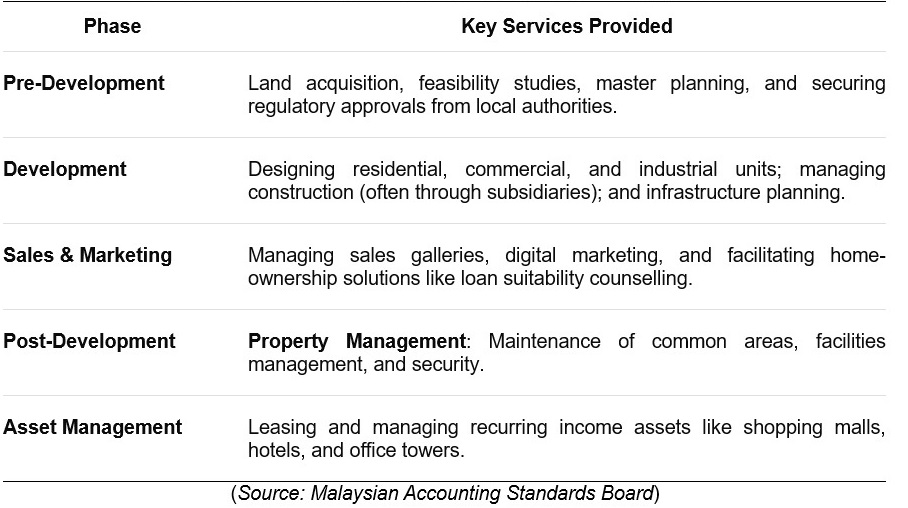
Four main types of companies drive the sector's lifecycle.
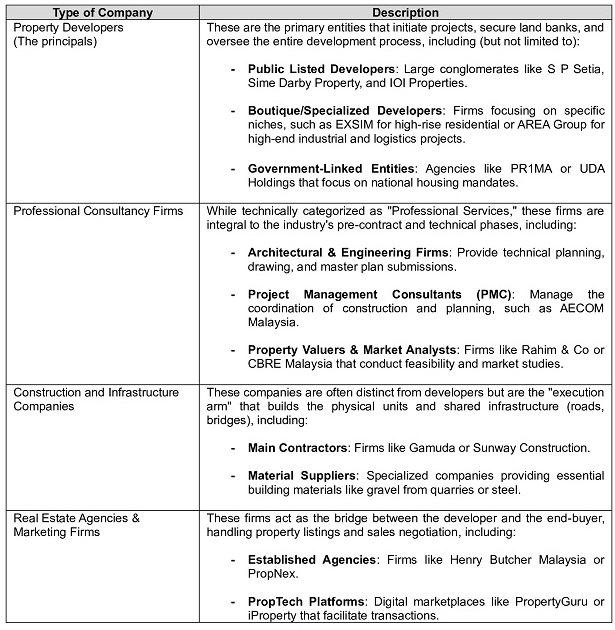
Property developers — the principals — initiate projects, secure land banks and oversee the entire development process.
These range from public-listed conglomerates like S P Setia, Sime Darby Property and IOI Properties, to boutique specialists such as EXSIM for high-rise residential or AREA Group for high-end industrial and logistics projects, as well as government-linked entities like PR1MA and UDA Holdings. Professional consultancy firms, while technically classified under professional services, are integral to the pre-contract and technical phases, encompassing architectural and engineering firms, project management consultants such as AECOM Malaysia, and property valuers and market analysts like Rahim & Co or CBRE Malaysia.
Construction and infrastructure companies form the execution arm that builds physical units and shared infrastructure, including main contractors such as Gamuda and Sunway Construction, alongside material suppliers.
Real estate agencies and marketing firms bridge the gap between developer and end-buyer, from established agencies like Henry Butcher Malaysia or PropNex to proptech platforms such as EdgeProp EPIQ.
At least 90% of players in the property development industry are estimated to be SMEs.
This is inferred from the fact that SMEs represent 90% of all registered construction companies — approximately 39,158 firms — and 89.2% of all establishments in the services sector, where real estate activities are classified.
These SMEs typically operate as niche developers focusing on small residential projects or specific regional towns, or as specialised subcontractors providing electrical, plumbing or site preparation services for larger projects.
Despite the large number of diverse players, the industry is highly concentrated.
According to a 2021 study by Public Investment Bank Bhd, the top seven large developers control more than 70% of the local market share, with a few companies monopolising land reserves and a combined estimated total development value (GDV) of nearly RM100 billion.
This stark concentration creates a rigid hierarchy within the property cycle.
However, the diversity of the industry's functions means there are countless niches where SMEs can thrive — and by adopting artificial intelligence (AI), smaller players can leverage real-time market analytics to find opportunities the giants might overlook, turning their smaller scale into an advantage of speed and intelligence rather than a liability of limited resources.
AI adoption in property development
Adopting AI is increasingly a critical economic necessity for SMEs seeking to maintain competitiveness in rapidly evolving markets.
For these smaller firms, AI serves as a "great equaliser," providing access to advanced tools — such as predictive analytics and real-time market insights — that were previously accessible only to large corporations with substantial budgets.
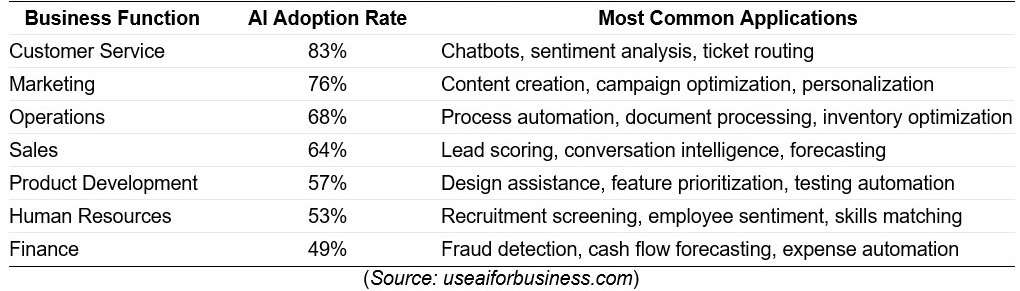
According to the 2025 “Artificial Intelligence Adoption Rates Among SMBs” report, approximately 78% of SMEs globally have implemented AI in at least one business function, with the highest adoption rates in customer service (83%), marketing (76%) and operations (68%).
About 31% of SMEs are specifically using Generative AI (GenAI), though only 29% of these users have embedded it into their core activities.
A "maturity gap" persists: only about 1% of firms are considered truly "mature" adopters, with AI fully embedded into their business models.
Sectorally, ICT (90%), manufacturing (80%) and healthcare (78%) lead in adoption.
The property development sector, at 63%, is rapidly closing its historical technology gap — shifting from experimental pilots to core operational deployment.
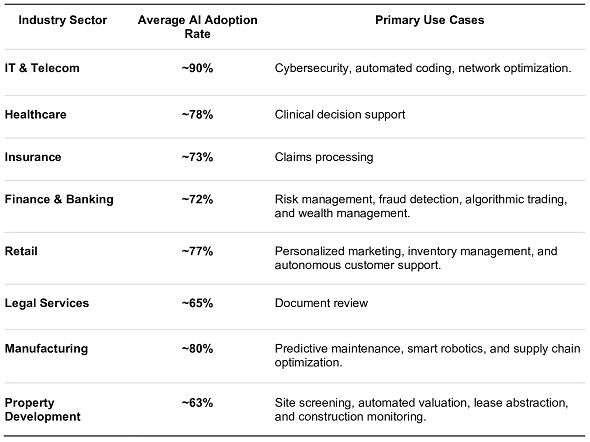
While it still trails high-adoption sectors such as IT and finance in absolute integration, it is now outpacing many other industries in the speed of adopting specialised agentic AI — autonomous systems capable of managing complex, multi-step workflows such as site selection and lease negotiation.
Malaysia is mirroring this global momentum. As of late 2025, 27% of Malaysian businesses have adopted AI, a significant jump from 20% just a year prior.
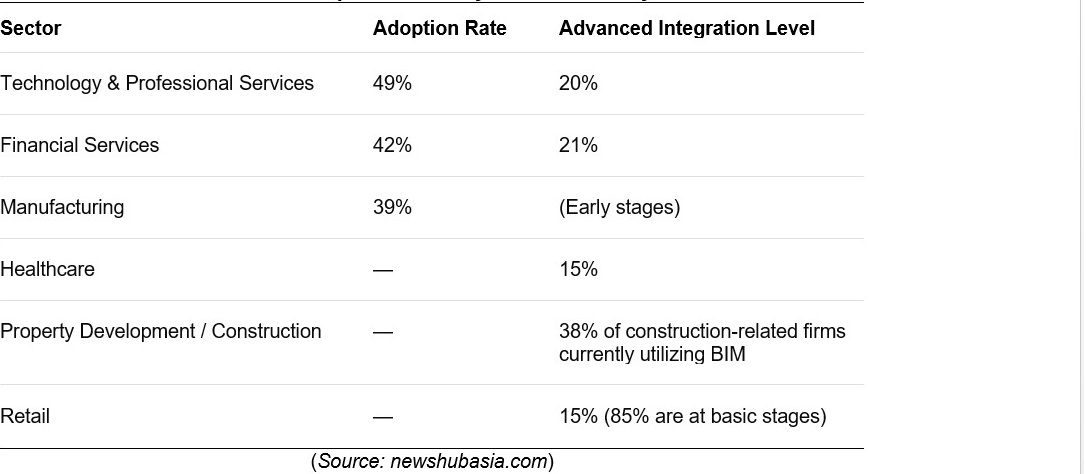
Technology and professional services lead at 49%, followed by financial services at 42%.
A "two-tier economy" is emerging: 48% of Malaysian startups use AI, with 31% building entirely new AI-driven products — significantly outpacing the advanced integration levels of larger enterprises.
Malaysia also ranks second in Asean for digital adoption in construction, with 38% of construction-related firms currently utilising Building Information Modelling (BIM).
Opportunities and bottlenecks
In the Malaysian property development landscape, AI is frequently — and incorrectly — associated with capital-intensive technologies such as advanced robotics or large-scale smart city infrastructure.
These perceptions lead many developers, especially SMEs, to categorise AI as a luxury accessible only to major corporations.
By 2026, however, a paradigm shift has repositioned AI from a speculative future investment to an essential operational utility.
As construction costs escalate and profit margins compress, competitive advantage is increasingly defined by operational velocity rather than the scale of land acquisitions.
AI enables SMEs to achieve a level of productivity disproportionate to their physical workforce, effectively bridging the gap between lean teams and large-scale corporations.
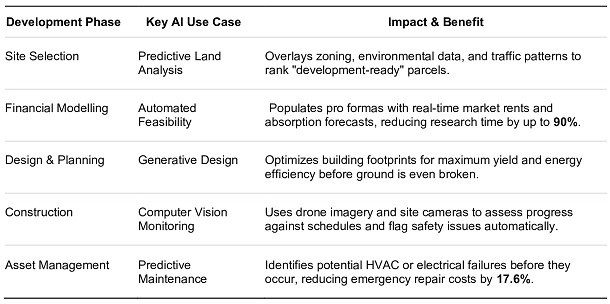
Despite these demonstrable advantages, many property players remain hesitant.
This inertia typically stems from three primary bottlenecks.
First, a prevalent "Capital Expenditure Bias" persists, where decision-makers incorrectly associate AI implementation with prohibitive upfront costs.
Second, ROI scepticism remains a barrier — traditional management structures often view digital transformation as an aesthetic luxury rather than a fiscal necessity, and without a quantifiable framework demonstrating how subscription-based tools translate into cost savings or increased sales velocity, board-level approval remains elusive.
Third, the perceived deficit of localised datasets within global AI frameworks deters adoption — most dominant AI models are trained on Western real estate paradigms and lack the granular data needed to navigate Malaysian market specificities, including Bumiputera quotas and localised valuation trends reported by the National Property Information Centre (Napic).
Beyond these, real estate is inherently fragmented, making it difficult for AI models to standardise and process inconsistent data from legacy systems.
Property transactions also involve sensitive personal and legal data, making AI systems potential targets for cyberattacks, including evasion attacks that alter model behaviour and privacy attacks that may reconstruct sensitive data.
Editor’s note: In Part 2, Dr Foo Chee Hung outlines a practical front-to-back AI adoption roadmap for Malaysian SME developers, including a plug-and-play toolkit of low-cost solutions.
Foo is a property professional who moderated the Q&A session at the AI Seminar organised by the Real Estate and Housing Developers’ Association (Rehda) Selangor on April 7. He holds a PhD in Urban Engineering from The University of Tokyo, and is the principal researcher of MKH Bhd.
The views expressed are the writer’s and do not necessarily reflect EdgeProp's.
..........
EdgeProp's monthly print edition is out! Free delivery is available for selected regions. Subscribe now.