Share
Share


This article appeared in the Sept 10, 2026 issue of the monthly print edition. Subscribe now.
The history behind Bandar Rimbayu is, on the surface, straightforward: to make a modern township lifestyle accessible to a broader segment of homebuyers.
For young families looking to raise their children away from the pace and density of the city, the township offers an alternative — more space, greenery and landed housing, while remaining connected to the wider Klang Valley.
That proposition has made Rimbayu particularly appealing to families looking to move up from condominiums or smaller urban homes into landed properties. A valuation report by Henry Butcher Malaysia dated Aug 29 last year attributes demand for housing in Rimbayu to its relative affordability, particularly among young couples looking to expand their homes as their families grow.
Situated in Kuala Langat, Selangor, its appeal lies largely in this trade-off: residents give up some proximity to central Kuala Lumpur in exchange for larger homes, more open space and a more suburban environment.
At first glance, Rimbayu may seem cut off from the rest of the Klang Valley, but it redeems itself with well-established connectivity. Accessible via four major highways — Shah Alam Expressway (Kesas), North–South Expressway Central Link (ELITE), South Klang Valley Expressway (SKVE) and Kemuning–Shah Alam Highway (LKSA) — residents enjoy seamless travel to key hubs like Subang, Petaling Jaya, Shah Alam, and KL city centre.
Since its launch in 2013, Rimbayu has also recorded strong take-ups across several of its residential launches. Its award-winning Robin development, for instance, saw all 308 units in its first two phases taken up within 28 minutes of its 2021 launch.
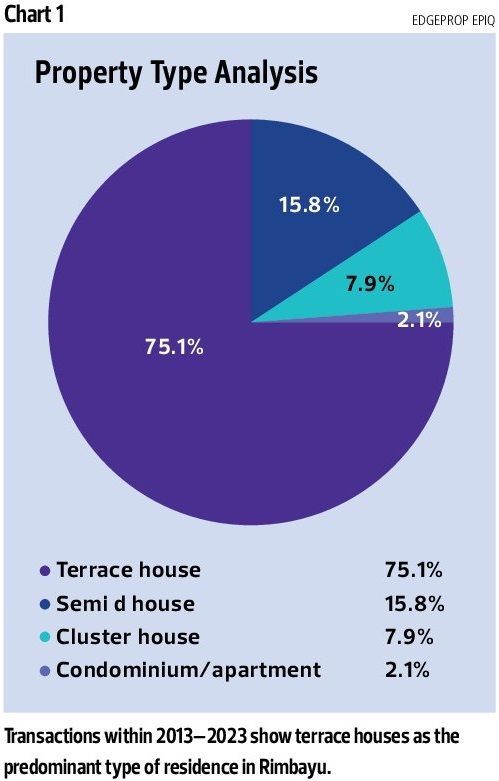
The township now spans 1,879 acres (about 760ha), with more than 5,000 homes and 323 shopoffices completed to date, developer IJM Land Bhd reported. Its housing stock remains predominantly landed, with terrace houses accounting for about 75% of property transactions from 2013 to 2023, according to EdgeProp EPIQ data (Chart 1).
Stepping up the value chain
As Rimbayu matures, so too does its price positioning.
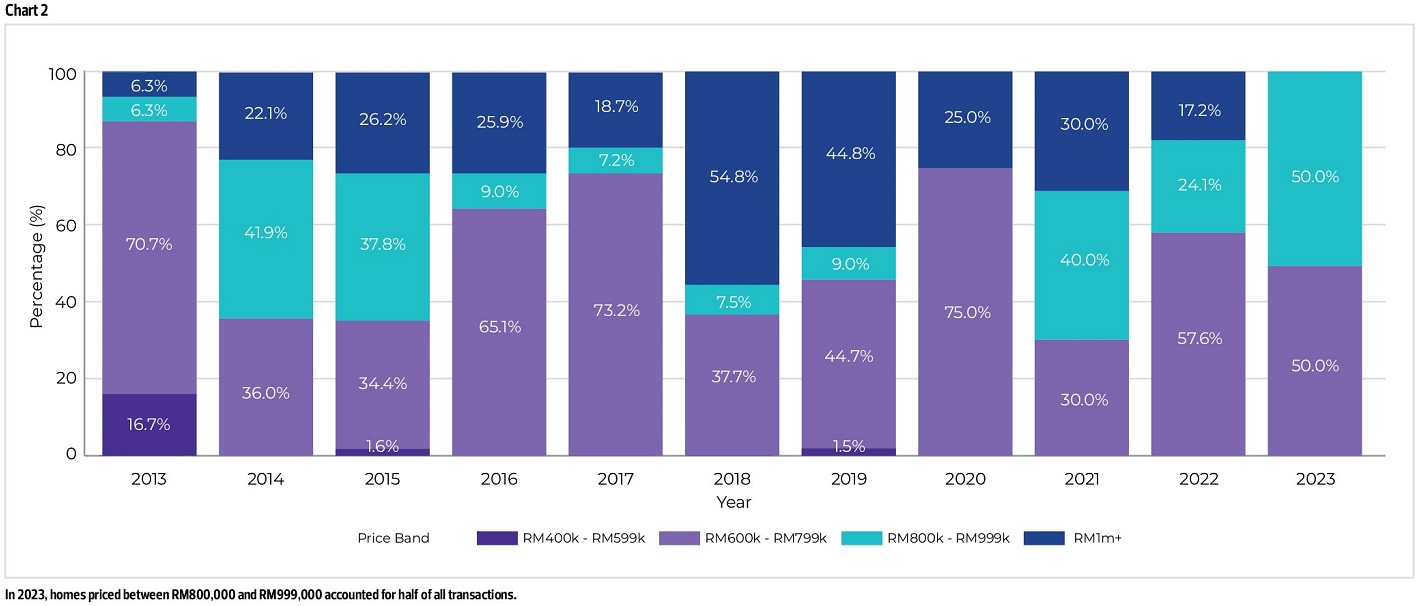
Landed property values have generally trended upwards over the past decade. Notably, EdgeProp EPIQ data show the average price psf for landed homes rose from RM408.30 in 2022 to RM496.50 in 2023, a 21.6% year-on-year increase — the strongest annual increase recorded over a decade (but this was based on a very thin volume of only two transactions in 2023, against 97 counts in the preceding year) (Chart 2).
The trajectory also reflects a broader change in IJM Land’s strategy for the township. For much of the past decade, IJM Land’s approach was centred on a mass-premium, volume-driven strategy. Developments such as Starling and Avela allowed the developer to reach a broader pool of buyers, with relatively accessible entry prices helping to generate strong take-ups and faster sale cycles.
Now, median residential prices in Rimbayu have exceeded RM1 million over two distinct periods.
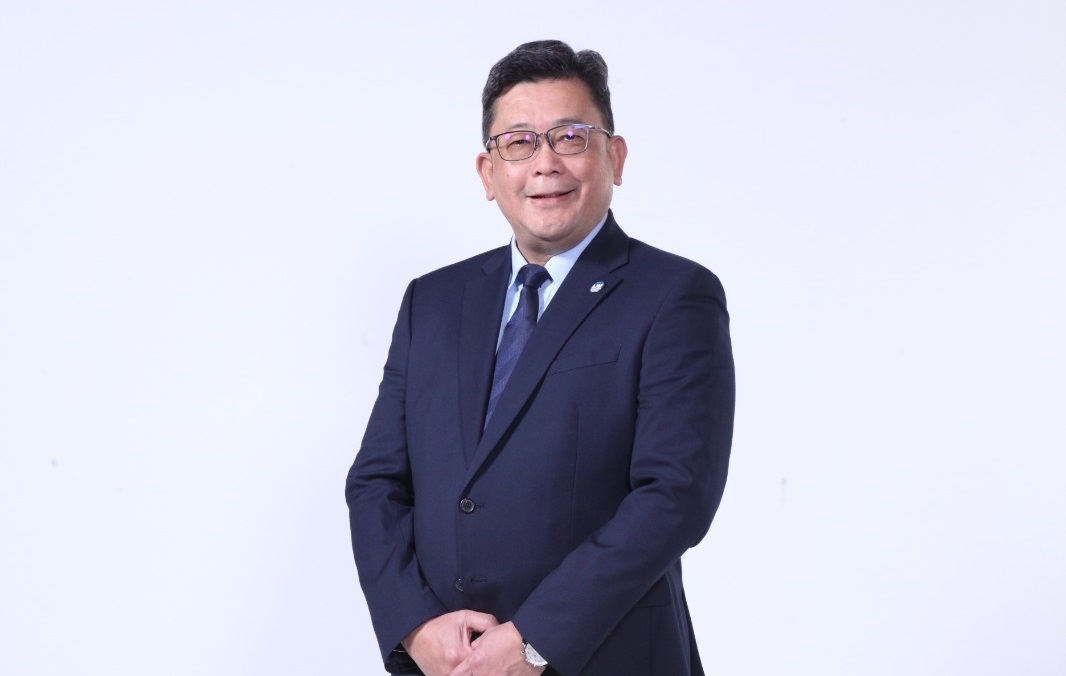
IJM Land Bhd chief operating officer Datuk Chai Kian Soon says that crossing the RM1 million threshold reflects a fundamental shift in buyer priorities — from purchasing merely a physical home to investing in a complete ecosystem.
“Buyers recognise that developing a master-planned township carries significantly higher capital investment than standard parcel development.
“They are willing to pay a premium because they are purchasing an entire neighbourhood framework — lush landscapes, signature central parks, international schools, commercial hubs, and wellness facilities right on their doorstep.
“The price resilience highlights strong market confidence in established townships that offer security, seamless connectivity, and longterm value appreciation,” he tells EdgeProp in a written response.
The developer has increasingly introduced higher-priced products aimed at upgraders and more affluent buyers.
One example is Anthea, a strata-titled landed development launched in September 2024, comprising two-storey superlink and semidee homes. The superlink units were priced RM1.98 million–RM2.76 million, while the latter ranged RM3.32 million–RM3.72 million.
According to Chai, the shift is deliberate: “We have taken care of first-time homebuyers and small families. Now, we are tapping into the more affluent market, which comprises not only our own residents, but also the neighbouring areas of Kota Kemuning, Subang Jaya, Shah Alam and Puchong”.
He says residents in these more mature areas would eventually look to upgrade and could be drawn to newer, well-planned townships such as Rimbayu.
Building a broader commercial ecosystem
As the township matures, the strategy is also becoming less reliant on residential development alone. Rimbayu’s next stage is increasingly about what happens after the houses are sold.
The growing residential population has created a larger captive market for retail, F&B, education and other services. IJM Land has responded by expanding the township’s commercial component, alongside recreational and educational facilities.
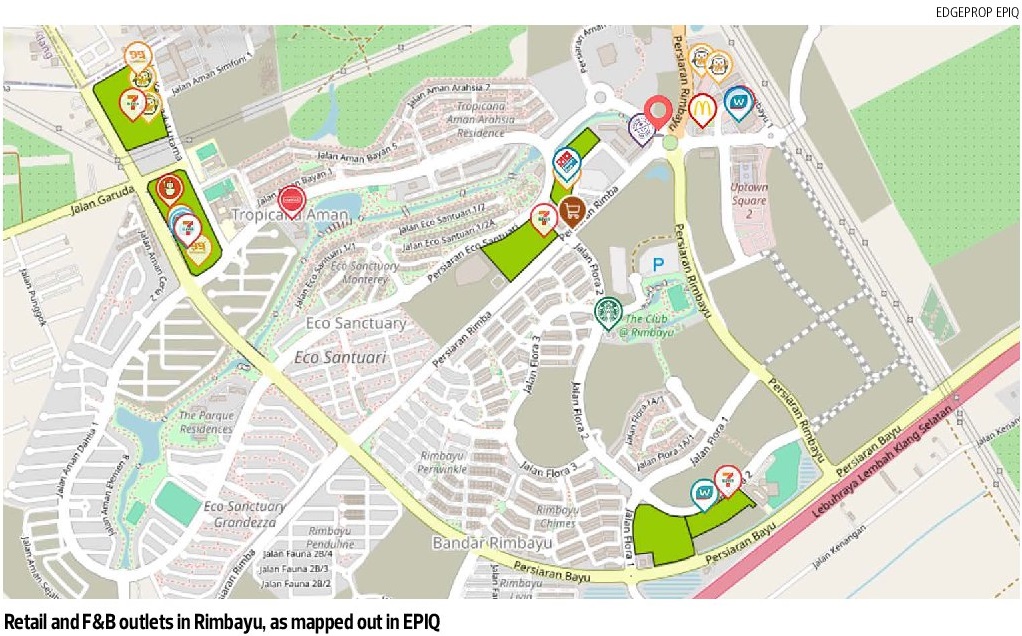
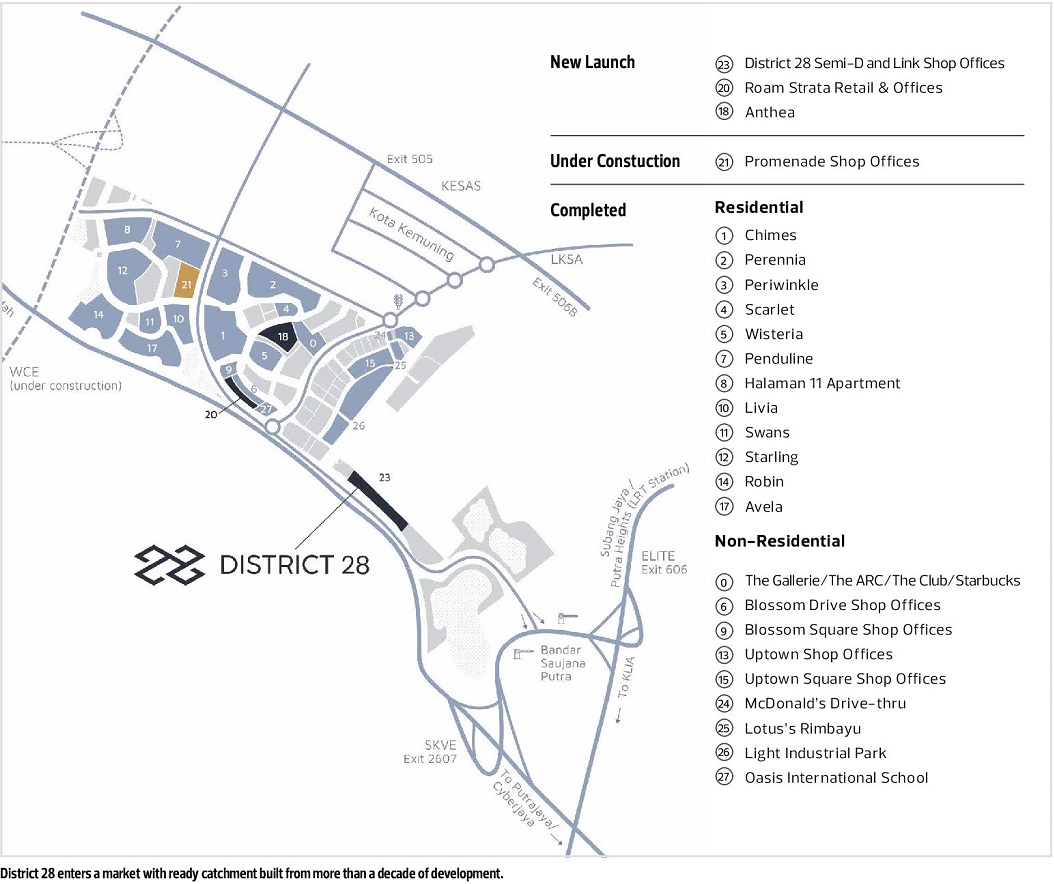
Major brands such as McDonald’s, Starbucks and Lotus’s have established a presence, while the township now has more than 300 completed shopoffices. Newer commercial developments, including District 28, are intended to add another layer to the business and retail ecosystem.
Its business hub, Uptown Square (U2), proved a success when all 119 shoplots were snapped up within a few days of its official launch on June 19, 2022, EdgeProp reported.
The leasehold shoplots, completed last year, were developed over two phases. They are sited in a combined land size of 17.45 acres and a gross development value (GDV) of RM308 million. The project offers two- and three-storey shoplots with eight layouts, some of which come with a balcony. The built-ups range 3,300–7,539 sq ft, while selling prices start from RM2.08 million.
Moving beyond the traditional shoplot model, IJM Land is now marketing District 28 as a more comprehensive business ecosystem, with 62 exclusive shopoffice units, roadside visibility and direct exposure to SKVE, targeting businesses ranging from retail and F&B to corporate and technology-oriented operations.
That does not mean Rimbayu has moved away from residential development. Residential accounts for 44% of the township’s master plan, compared with 13% allocated to commercial development, according to the IJM Rimbayu website.
But as the residential base matures, IJM Land is placing greater emphasis on commercial development to serve and monetise the population it has built up.
In that sense, Rimbayu’s story is no longer simply about selling houses. It is about whether the township can convert a growing residential population into a sustainable urban ecosystem, and whether that maturation can continue to push the development further up the property value chain.
The commercial story is fundamentally tied to population density. In 2022, IJM Land projected that Rimbayu’s population could reach 100,000 within five years, while developments such as a proposed logistics/distribution centre were expected to bring additional workers into the area.
The current 5,000-plus completed homes provide a substantial existing customer base, while continued residential development should expand it further.
Chai says that sustaining momentum requires transitioning from building homes to cultivating a thriving, multi-layered economic and social ecosystem.
“A key part of this is consistently delivering on early promises by introducing essential amenities like recreational hubs [such as] The ARC, The Club and Linear Park, retails, and educational institutions, which builds deep buyer trust and ensures everyday convenience.” He adds that at the same time, product offerings must continuously evolve alongside shifting market demographics.
“At IJM Rimbayu, our portfolio spans from entry-level and move-up landed homes to luxury residences and innovative commercial formats, such as our recent ROAM strata retail and offices for young entrepreneurs and District 28 semidee shopoffices for regional brands and showrooms.
“Crucially, residential, commercial, and industrial components must reinforce one another. By selling commercial and industrial land to key corporate partners including logistics players like J&T Express, healthcare providers, and corporate offices, this creates localised employment opportunities, drives footfall to existing business hubs, and generates a self-sustaining cycle of long-term demand across the entire master plan,” Chai elaborates.
“It gives retailers something they really need: a captive residential catchment, rather than having to depend entirely on people driving in from elsewhere,” he adds.
..........
EdgeProp monthly brings you data, insights and solutions for an evolving market. Subscribe now for your free copy!