Share
Share


This article appeared in the Sept 10, 2026 issue of the monthly print edition. Subscribe now.
As the greater Klang Valley, especially Kuala Lumpur, accelerates towards global city status, a wave of upgrades has become an integral part of the urban storyline — reshaping infrastructure, reimagining public spaces and reinvigorating the city’s inter‐ national appeal.
On the retail front, malls have shifted from being mere shopping stops to full‐fledged life‐ style destinations, offering immersive experiences that stretch far beyond retail. To stay competitive against this new generation of experiential hubs, many older malls across the Klang Valley have rushed to refurbish and reinvent themselves.
However, this hasn’t been the story for all malls. Despite a general consensus among industry players that ageing malls will now have to reposition or repurpose to stay relevant in the region’s rapidly-evolving landscape, this is much easier said than done for a certain category of malls.
Many of the early malls were developed on a stratified ownership model, meaning they are not owned by a single entity, but divided into strata titles owned collectively by multiple individual owners. This ownership structure creates significant complexities whenever change is proposed — with the common issues being a prolonged decision-making process, challenges in raising appropriate funds, and the ambiguity of laws governing the whole process.
For clarity, strata malls are not a thing of the past. A number of modern retail centres continue to employ a strata system of ownership. However, these are newer buildings that are better planned, built and designed to meet contemporary expectations. Ageing strata malls, with limited lifestyle appeal, dated interior spaces and high energy consumption, are not.
“For malls, change is actually a constant part of the cycle, implemented from time to time to refresh and retain their appeal. For older malls, upgrades to facilities are also important in order to cope with modern operational costs, while maintaining the ability to attract both retailers and shoppers to the premises,” explains former Malaysian Shopping Mall Association (PPK Malaysia) president and RCMC Sdn Bhd director Richard Chan. (RCMC stands for Retail Concept Management Consultancy.) In order to stay competitive, ageing retail centres need more than cosmetic upgrades. They require improvements that can facilitate better-managed buildings, cost-effective operations and attract the right retail and F&B mix that will lure healthy footfall, Chan tells EdgeProp.
What’s the hold-up?
In a strata retail building, the lots are individually owned, but the management, maintenance and servicing of all elements in common areas are undertaken by the joint management body (JMB) or management corporation (MC). The individually-owned lots are maintained and managed by the owners themselves, but the building management’s role is to ensure that owners meet the overall standards and requirements of the building.

Owners contribute to a service charge, which is paid towards regular maintenance and a sinking fund, which is collected for the purpose of renovations and upgrades over time.
“Typically, these sinking funds are set at a basic amount, to accommodate affordability for owners. So, when we talk about large-scale renovations, the type required to refurbish and reposition a mall, the sum saved in the sinking fund is nowhere close to the amount required to cover such a cost,” says Chan.
Offering further insight, lawyer Lee Kim Noor, a partner at K N Lee & Associates, says that sinking fund contributions are legally set at 10% of the service charge rate.
“Hypothetically, if the service charge is in the region of RM500, that means only RM50 goes towards the sinking fund. If that is the contribution per owner, even after a period of time, you can imagine that it does not quite add up to a sizeable amount.
“To put things in perspective, recent renovations at The Summit USJ [in Subang Jaya, Selangor] cost in the region of RM70 million,” she tells EdgeProp.
Lee says modern necessities such as EV charging stations at car parking lots, energy-efficient air-conditioning systems and proper waste refuse also add to the overall cost. The owners can be asked to top up, and they may even agree that an upgrade is necessary for the commercial building to survive, but it is quite a hurdle when the sum required is beyond their means to raise.
Both Lee and Chan agree that bank loans are an oft utilised solution to bridge the affordability gap, sometimes in the form of individual loans to meet the required top-up amount, and sometimes secured by the building management itself, with a sound plan to contribute the savings resulting from upgraded facilities towards the loan repayment.
Either way, owners must first be convinced that the proposed improvements will result in better rental earnings and better investment returns before committing to change.
Shackled path to reach consensus, initiate action
The process begins with a study on what improvements need to be made, and why, and an assessment of the total renovation cost, says Chan. Following this, the plan needs to be approved by the MC before it is presented to owners at an AGM.
Owners then reach a consensus via a vote, and if the majority agree, then they proceed to raise funds via added contribution from owners. Without a majority agreement, the plan cannot proceed.

“Reaching a consensus itself is sometimes a difficult task. Not all may agree on the cost, and not all may be comfortable with spending on an extra investment,” says Chan.
“Even if there is a majority agreement in place, there could be delays in raising funds, because some owners may simply object to paying. One of the main problems many strata malls are facing now is legal clarity on this process. Often, when such issues are addressed in court, the owners are not compelled to pay because the process was not done correctly,” Chan points out, adding that the legal “process” is currently far too vague and very open to interpretation.
Explaining the legal context behind the pro‐ cess, law firm AJ Ariffin, Yeo & Harpal manag‐ ing partner Datin Harwinder Kaur says: “The committee manages day-to-day affairs within its powers, while matters reserved for proprie‐ tors are decided at an annual or extraordinary general meeting after proper notice and voting”.
“Unless the Strata Management Act 2013 (Act 757) or Strata Titles Act 1985 (Act 318) requires a higher threshold, an ordinary resolution is passed by a simple majority of valid votes cast. Neither 80% support nor every proprietor’s consent is the general rule. A special resolution requires at least 75% of valid votes cast,” she tells EdgeProp.
“Under Act 757, a unanimous resolution re‐ quires every valid vote cast to support it; under Act 318, it means no vote is cast against it. A comprehensive resolution follows a special procedure and requires support representing at least two-thirds of the aggregate share units of all parcels. The threshold, therefore, depends on the particular power being exercised,” Harwinder elaborates.
She says even those who vote against a resolution are legally compelled to pay if the resolution is validly passed and falls within the body’s statutory powers.
“If common-property refurbishment is properly approved and is a permitted use of the sinking fund, all owners remain liable to pay the charges and sinking-fund contributions lawfully imposed on their parcels. Like taxation, disagreement with a collective decision does not remove the obligation to contribute,” Harwinder explains.
However, she qualifies that majority rule is not unlimited.
“A resolution may be challenged if notice, quorum or voting requirements are not observed, if the expenditure falls outside the permitted purposes of the fund, or if the proposal exceeds the JMB’s or MC’s powers. It also cannot override planning, building or fire-safety requirements,” she adds.

Laws governing strata retail need sharpening
Harwinder further explains that the principal legislations governing all strata buildings are Act 757, the Strata Management (Maintenance and Management) Regulations 2015, and Act 318.
“Act 757 governs management, meetings, charges, sinking funds, by-laws and enforcement. Act 318 deals principally with strata titles, common property, the MC, limited common property and subsidiary MCs,” she says.
Harwinder points out that there is no separate governance code for shopping malls. Within the territorial reach of these Acts, the same basic framework applies to residential, commercial and mixed developments.
“The central limitation [of present legislation] is its broadly uniform governance model, although different strata properties have different needs,” she says.
“A mall, however, is a commercial ecosystem. Its survival may depend on coordinated and time-sensitive decisions concerning tenant mix, anchor tenants, branding, signage, facade treatment, air-conditioning, circulation, marketing and repurposing,” she adds.
Harwinder believes fragmented ownership creates a collective-action problem. Some owners may be absent, financially distressed or opposed to capital expenditure, while others may benefit from improvements without wanting to fund them.
“The delay itself can destroy commercial value,” she asserts.
She says the legislation offers only limited recognition of mixed-use complexity. Disputes also arise over what constitutes common property, who benefits from particular facilities and whether proposed works amount to repair, upgrading or a more fundamental alteration.
“Older strata malls can therefore become trapped in disputes and unable to reposition themselves,” Harwinder says.
On how the law could be improved, she says: “There should be dedicated provisions for commercial and mixed-use strata developments. The law should clearly distinguish between repair, replacement, upgrading, facade alteration, structural alteration and repurposing, with an appropriate approval route for each. It should permit fair cost allocation based on in‐ dependently-assessed benefit, usage and cost causation, rather than a blanket uniform rate”.
Harwinder adds that other reforms should include long-term capital-works plans and sinking-fund forecasts; an easier route to create limited common property and subsidiary MCs; class voting for directly-affected owners, with safeguards against majority abuse; and a tribunal or court mechanism to resolve deadlocks where a commercially-necessary propos‐ al has substantial support and dissenting owners are treated fairly.
The good news is, she says, reform is underway. In June, the Housing and Local Government Ministry (KPKT) announced it was gathering stakeholder input for comprehensive amendments to Act 757. In August, KPKT minister Nga Kor Ming stated that the National Housing Policy 2026–2035 envisages amendments to Act 757 and a new Building Managers Act.
While these are useful steps, Harwinder hopes the reforms expressly address the commercial viability and governance needs of malls and mixed developments, rather than merely strengthening a predominantly residential model.
For now, solutions lie in innovation, better planning
Currently, there are a few examples of older malls that have successfully undertaken renovation and upgrade works, says Chan.
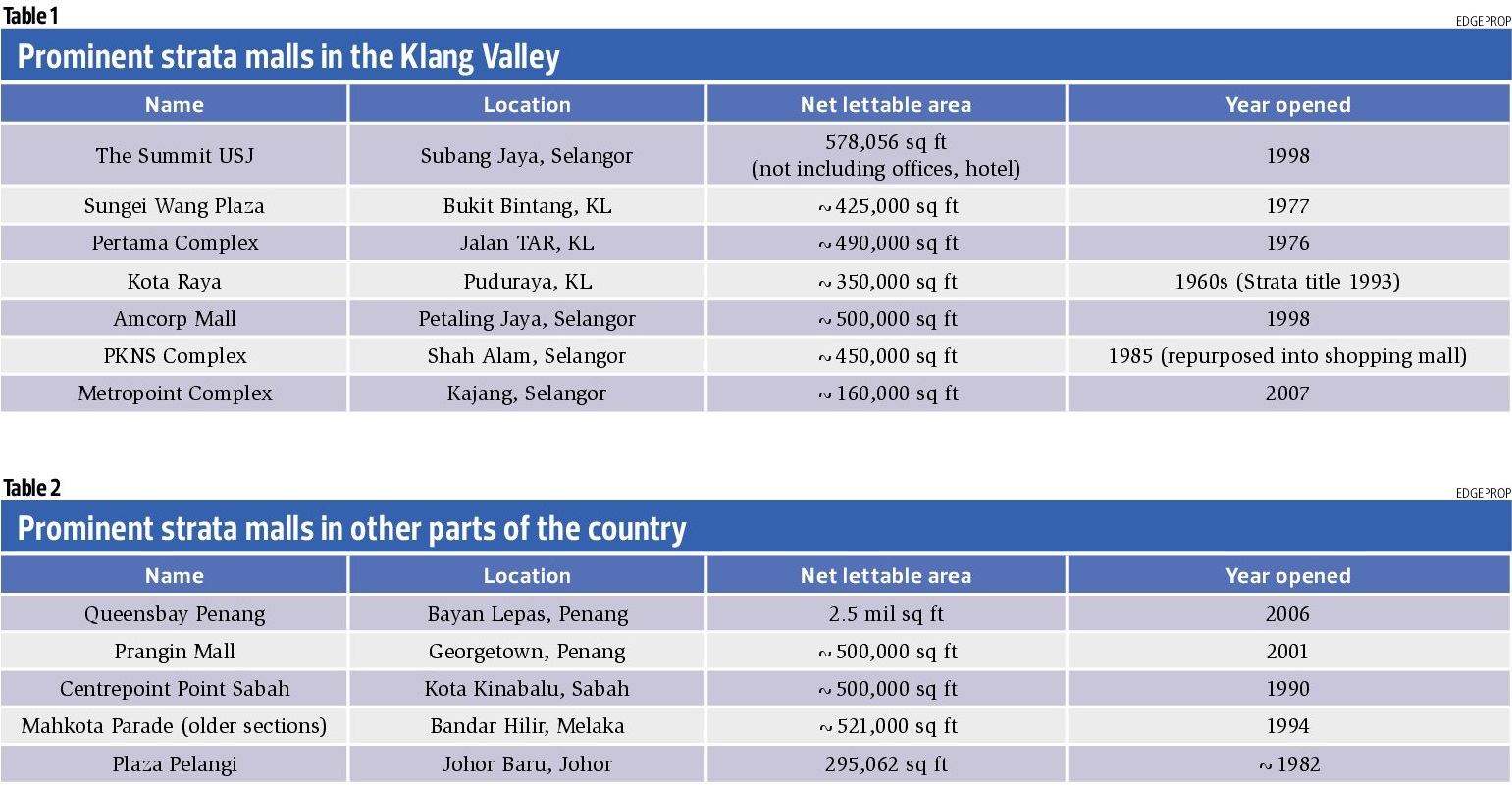
Apart from The Summit USJ, Sungei Wang Plaza in Bukit Bintang, KL, has undergone successful change and continues to thrive in an environment of modern malls within the city’s prime shopping district.
“In the Sungei Wang scenario, the car park area was renovated to create new retail space. Because of its location, they were able to charge a healthy premium for this, and the earnings were used to help cover overall renovation costs,” Chan says, pointing out that innovative solutions can be used to raise necessary funds.
Another innovative solution is a share-prof‐ it with contractors providing the upgrade. For example, if a new energy-efficient air-conditioning or solar-power system is installed, the building management can work in partnership with the contractor to share a percentage of the savings, which helps avoid paying heavy upfront costs.
In some cases, Chan says, the management can use projected savings as a form of “collateral” and work in partnership with banks to secure loans, or negotiate an attractive repayment scheme.
“In the long run, however, improved legislation will help create a better environment for well-managed strata retail property, which is ultimately what sustains a building’s value and relevance over time. However, the regulations must be clear, precise, transparent and fair to all parties,” Chan says.
Lee says any amendments to Act 757 should include better provisions for raising funds for upgrades, such as an increase in the sinking fund quantum for commercial buildings.
“The current 10% is insufficient, and a quantum of 15% has been suggested previously by the Commissioner of Buildings,” she says.
“Also, strata retail malls themselves have to employ long-term strategies to manage constant upgrades and necessary renovations. After upgrades, for example, they must recommit a portion of the savings into the sinking fund for inevitable future upgrades,” she adds.
Lee explains that greater financial strength will also mean lower top-ups for owners when the time comes, and the JMB/MC will be in a better position to negotiate longer-term and more affordable payment schemes with owners.
This will help remove the cost resistance from owners, and speed up the entire decision-making and plan execution process.
..........
EdgeProp monthly brings you data, insights and solutions for an evolving market. Subscribe now for your free copy!