Share
Share


(Second of a two-part series)
In the first part of this series, we examined how AI adoption is reshaping Malaysia's property development landscape and the bottlenecks that continue to hold many SME developers back. Here, we outline a practical, phased roadmap that smaller developers can follow to integrate AI without heavy capital outlay.
The front-to-back approach
To successfully transition from digital hesitation to operational integration, Malaysian developers — SMEs in particular — should adopt a phased, strategic implementation roadmap that keeps AI adoption fiscally responsible while maximising immediate functional gains.
Unlike large developers with dedicated digital transformation departments, the Malaysian SME developer operates in a state of "lean combat."
A single manager often juggles land acquisition, marketing and site supervision simultaneously, relying heavily — and expensively — on external agencies for 3D renderings, social media management and lead generation.
This creates a rigid capital cycle and a deep-seated reluctance to invest in anything without a clear, immediate return on investment (ROI).

This mindset is not exclusive to SMEs. Even for industry giants, the traditional model of bloated internal departments is being replaced by a leaner philosophy to mitigate risk, as high overheads can become liabilities during economic shifts.
Whether a developer is a boutique firm or a conglomerate, the goal remains the same: ensuring that every dollar spent on technology directly fuels the bottom line.
In contemporary practice, the most impactful solutions are delivered via "Plug-and-Play" Software as a Service (SaaS) models — often representing a lower monthly overhead than standard utilities, and designed for high usability requiring only the foundational digital literacy already found in most teams.
Given the lean nature of Malaysian SME developers, the strategic priority should follow a "Front-to-Back" approach: prioritising phases that offer the highest transaction velocity and immediate cost displacement before moving into high-capital construction technology.
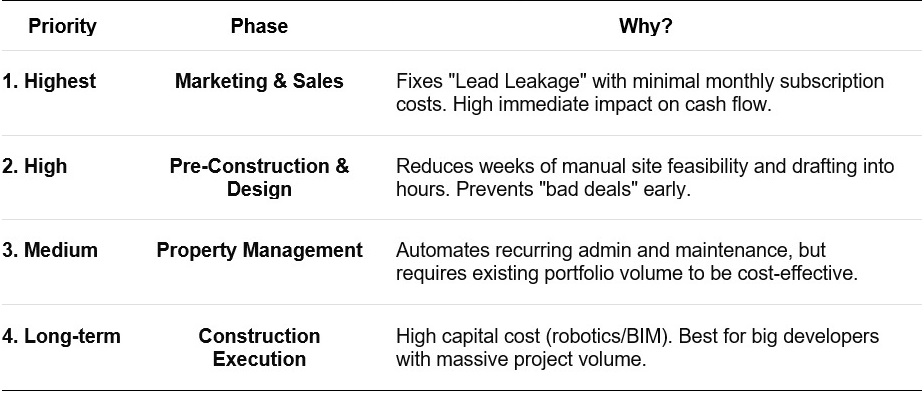
The adoption priority matrix
The roadmap is structured across four tiers:
*Highest priority — Marketing and sales: Fixes "lead leakage" with minimal monthly subscription costs; high immediate impact on cash flow. AI acts as a 24/7 virtual sales gallery, capturing and nurturing leads that a lean team might miss after hours — with no heavy upfront capital commitment.
*High priority — Pre-construction and design: Reduces weeks of manual site feasibility and drafting into hours; prevents costly "bad deals" early. AI serves as a high-speed "risk filter," identifying underperforming land parcels before they result in significant losses.
*Medium priority — Property management: Automates recurring admin and maintenance workflows, but requires existing portfolio volume to be cost-effective. Predictive maintenance can slash emergency repair costs by 40% to 60% and is best suited to developers transitioning from pure development to long-term asset management.
*Long-term — Construction execution: High capital cost involving robotics and advanced BIM; best suited to larger developers with significant project volume. For the growing SME, this represents the "scaling stage" to be tackled once the preceding three tiers are digitised and stable.
The plug-and-play toolkit
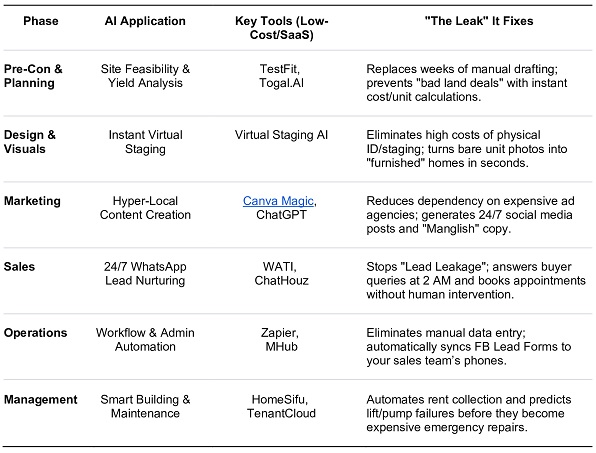
A practical AI toolkit for Malaysian developers spans the full project cycle:
*TestFit and Togal.AI — site feasibility and yield analysis; replaces weeks of manual drafting and prevents bad land deals with instant cost-per-unit calculations
*Virtual Staging AI — instant virtual staging; eliminates the high cost of physical interior design staging by turning bare unit photos into furnished homes in seconds
*Canva Magic and ChatGPT — hyper-local content creation; reduces dependency on expensive ad agencies and generates social media posts and Manglish copy around the clock
*WATI and ChatHouz — 24/7 WhatsApp lead nurturing; stops lead leakage by answering buyer queries at 2 AM and booking appointments without human intervention
*Zapier and MHub — workflow and admin automation; eliminates manual data entry by automatically syncing lead forms to the sales team
*HomeSifu and TenantCloud — smart building and maintenance management; automates rent collection and predicts equipment failures before they become costly emergency repairs
The lean team's competitive edge
The success of industry leaders such as Gamuda Land, Juwai IQI and Sime Darby Property — which have deployed marketing and sales AI to eliminate consultation delays, bridge lead response gaps and bypass agency bottlenecks — serves as powerful proof of concept for smaller players.
Read also:
The front-to-back AI roadmap: Understanding Malaysia's property development landscape
For the SME developer, this is more than a trend; it is a proven blueprint for sales acceleration through low-capital, high-impact technology.
AI adoption for Malaysian SMEs does not demand an overnight overhaul or a massive capital drain.
By adhering to the front-to-back strategic priority, companies can channel limited resources into high-impact zones — prioritising immediate cash flow generation in marketing before transitioning toward critical risk mitigation in pre-construction.
For the lean combat team of a Malaysian SME, digital transformation is a tactical necessity, not a vanity project. By embracing this phased approach, a lean structure becomes a competitive advantage — enabling faster decision-making and lower overheads than larger, more bureaucratic rivals.
In the modern property landscape, agility powered by AI is the ultimate equaliser.
Foo Chee Hung is a property professional who moderated the Q&A session at the AI Seminar organised by the Real Estate and Housing Developers’ Association (Rehda) Selangor on April 7. He holds a PhD in Urban Engineering from The University of Tokyo, and is the principal researcher of MKH Bhd.
The views expressed are the writer’s and do not necessarily reflect EdgeProp's.
..........
EdgeProp's monthly print edition is out! Free delivery is available for selected regions. Subscribe now.